
Healthcare
Marketing for Dental Practices
A dental patient isn't worth a procedure, they're worth twenty years of six-month visits. Which means most of your growth is already sitting in your own charts.
Who this is for
Most of your growth is already in your own charts.
A dental patient isn’t worth a procedure. They’re worth twenty years of six-month visits, plus whatever work comes up along the way, plus their family. Almost nothing else we market has a customer who is supposed to come back on a schedule for decades.
Which changes where the opportunity sits. You don’t have a stack of strangers to go and find. You have a list of people who already chose you once and quietly stopped coming.
Nobody fires their dentist. They just don’t rebook.
They moved, or a job changed, or one appointment got canceled in a busy month and nothing ever replaced it. They’re still in your system. They still think of you as their dentist. Nobody has asked them back in three years.
That’s a different problem from the one every agency wants to sell you, which is more new patients at the top. New patients are worth having. They’re just the most expensive way to fill a schedule that already has hundreds of lapsed people sitting in it.
Why this practice is its own challenge
Three things about a dental practice that aren’t true next door.
You’re running two businesses in one building
Hygiene and recall is high volume, insurance-shaped and built on habit. Implants, ortho and cosmetic work is researched for weeks and often paid for directly. They need different pages, different searches and different follow-up, and a site that only speaks to one of them is quietly losing the other.
The first question is about coverage
For most of your schedule the deciding question isn’t whether you’re good, it’s whether you’re in network. If your site won’t answer that, the call becomes an admin call, or it goes to whoever did answer it. That’s the reverse of a cash-pay practice and it changes what the site has to do first.
Some of it is an emergency at the worst hour
A cracked tooth on a Saturday is decided in minutes by whoever picks up. Nobody in that state reads a website, compares three practices or waits until Monday. It’s also how a lot of people come back at all. Somebody who has been putting it off for years doesn’t return because of a reminder, they return because something finally forced them, and whoever answers that call inherits them for the next twenty years.
The review rules land on you harder than on the others
Replying to a patient review can itself be a disclosure, because confirming somebody was a patient is the disclosure whatever else the reply says. That applies to every practice on this site. It matters most here for an unglamorous reason: a practice seeing thousands of patients and replying to hundreds of reviews simply has more chances to get one wrong.
So what a reply can say, who signs it off and how the asking is done get worked out with you before anything goes live, rather than after. The service, and what changes for a practice, is here.
None of this is legal advice and we’re not the people to give it. Your obligations are yours, and your board sets its own rules about what may appear in your advertising. Where those touch what we’d publish for you, we’d rather ask than assume.
What people actually type
Two completely different searches, and one of them is panicking.
One is routine and shops on logistics. A dentist near them, open at a time they can make, taking their insurance. The other has just broken something, or has spent a month reading about implants and is finally ready to ask what it costs. The one who has just broken something is often not a new patient at all, but somebody who last sat in a chair years ago. Same practice, and almost nothing in common.
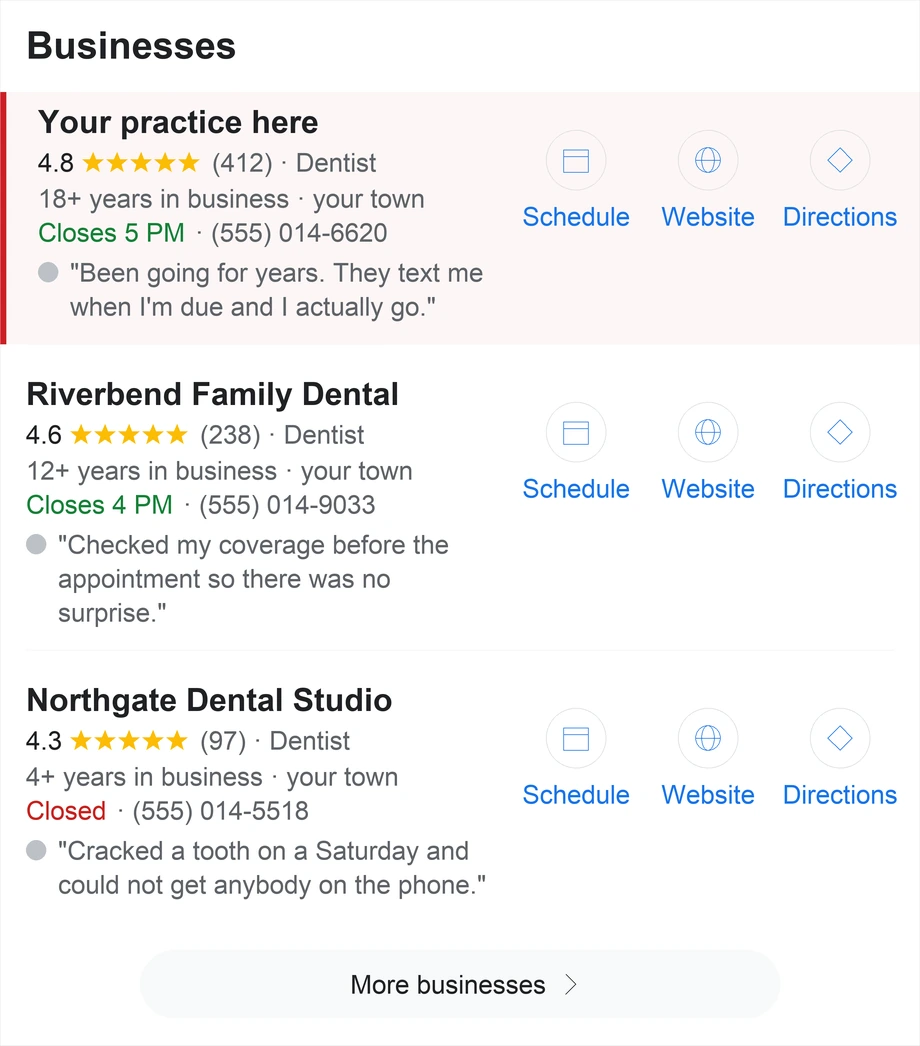
Read what those three lines are about
Not one of them mentions dentistry. One practice gets credit for texting somebody when they were due. Another for checking coverage before the appointment instead of surprising them after. The third loses on a cracked tooth and a phone nobody answered on a Saturday.
Those are the three things that actually decide this category, and all three are operational rather than clinical. Nobody is comparing your technique. They’re comparing whether you make it easy.
We aim at the top three positions in the maps in Google and keep you there, for what people actually search. Nobody can honestly promise the top spot, here or anywhere.
The expensive conversation happens in the chair
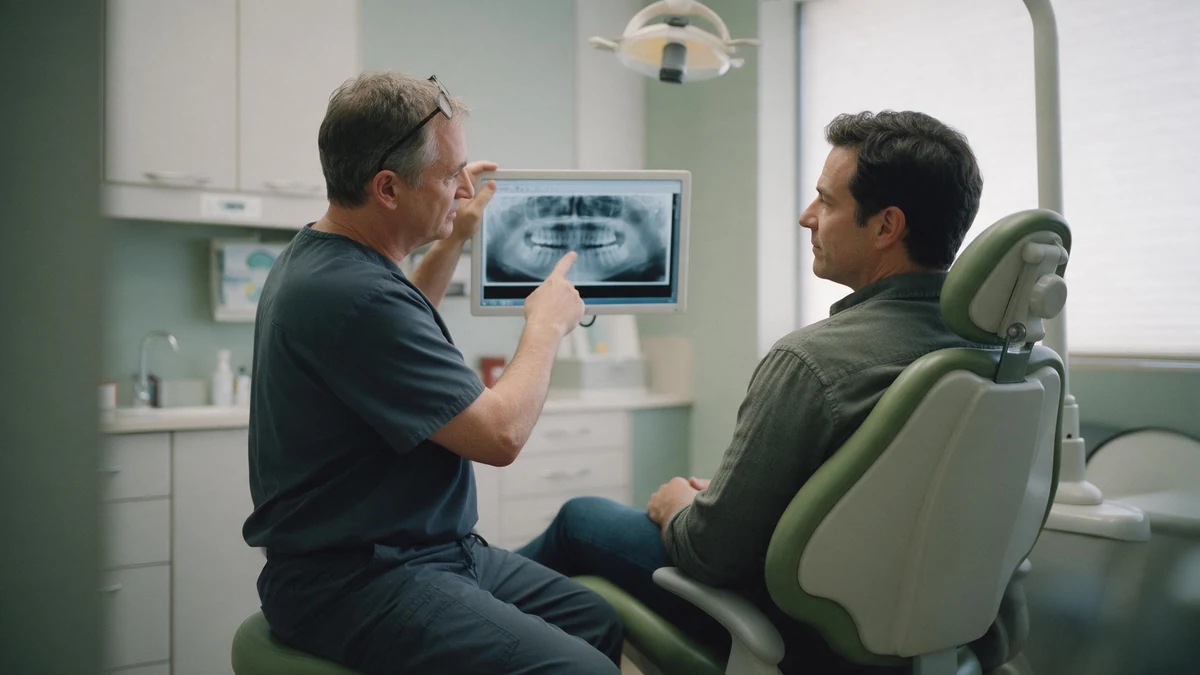
The big cases are usually sold to somebody who is already your patient. They came in for a cleaning, something showed up on an image, and the treatment gets explained while they’re sitting there. Which is exactly why the recall schedule is worth more than it looks: it’s the only reliable way to get somebody in front of you often enough for that conversation to happen at all.
The ones who lapsed aren’t just missed cleanings. They’re the cases nobody ever got to have the conversation about.
The one that decides it
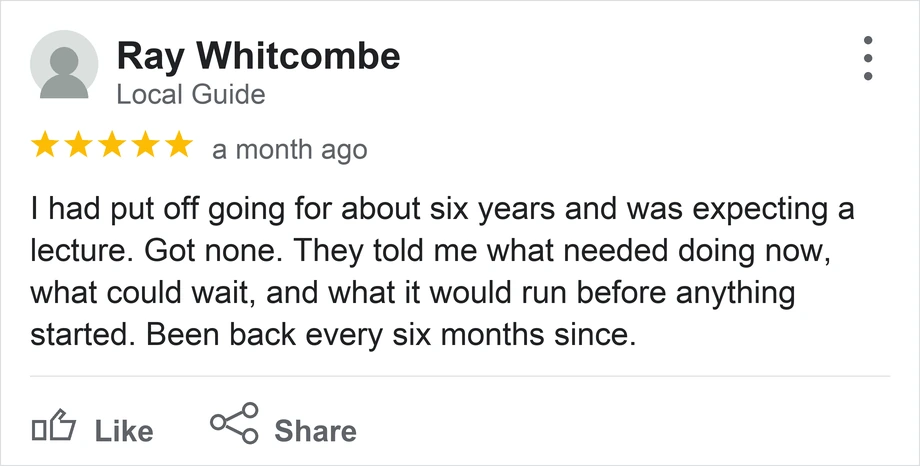
The review that wins you patients is about being treated like an adult.
Notice what that patient was afraid of
Not the drill. The lecture. He’d avoided going for six years and expected to be told off for it, and the thing he wrote about afterwards was that nobody did. Then what needed doing now, what could wait, and what it would run, before anything started.
A large share of the people not currently going to any dentist are avoiding it for that reason rather than a practical one. Reviews that say the shame didn’t happen do more to move them than anything you could write about yourself, because it’s the one claim nobody believes coming from the practice.
And it’s a review about how somebody was handled, not about a clinical outcome, which is the half that’s safe to lean on. How we ask, and what a reply is allowed to say, is here.
Where a dental practice usually starts
Start with the people who already know you.
Almost nobody should buy all of it at once, and here the cheapest thing on the list goes first, because you already paid to acquire these people once.
In the order it usually makes sense
Straight answer
When this isn’t the right call.
If your hygiene schedule is already full
Leave the top of the funnel alone and say so. A practice booking new patients it can’t fit turns them into a six-week wait, and a six-week wait is where a new patient becomes somebody else’s patient.
If the phone doesn’t get answered
Then nothing above the phone is worth buying yet. More visibility into a line nobody picks up is paying to send people to a competitor, and in the emergency half of this work it’s the entire result.
If you want claims we can’t support
We won’t write that a treatment cures, fixes or guarantees anything, and before-and-after work carries rules of its own that your board sets rather than us. We’d turn the work down before we’d argue about it.
Frequently Asked Questions
The things worth asking before you buy.
What's the fastest way for a dental practice to fill its schedule?
Read more on this topic: Reaching the patients you already have
Why do dental practices need different marketing for implants than for cleanings?
Does a dental practice need its phone answered outside office hours?
Read more on this topic: What happens to the call nobody picks up
Can you reply to patient reviews for a dental practice?
Read more on this topic: Who signs off a reply, and what it may contain
What kind of dental review actually brings people in?
Read more on this topic: What we ask for, and the kind that moves people
Book a call
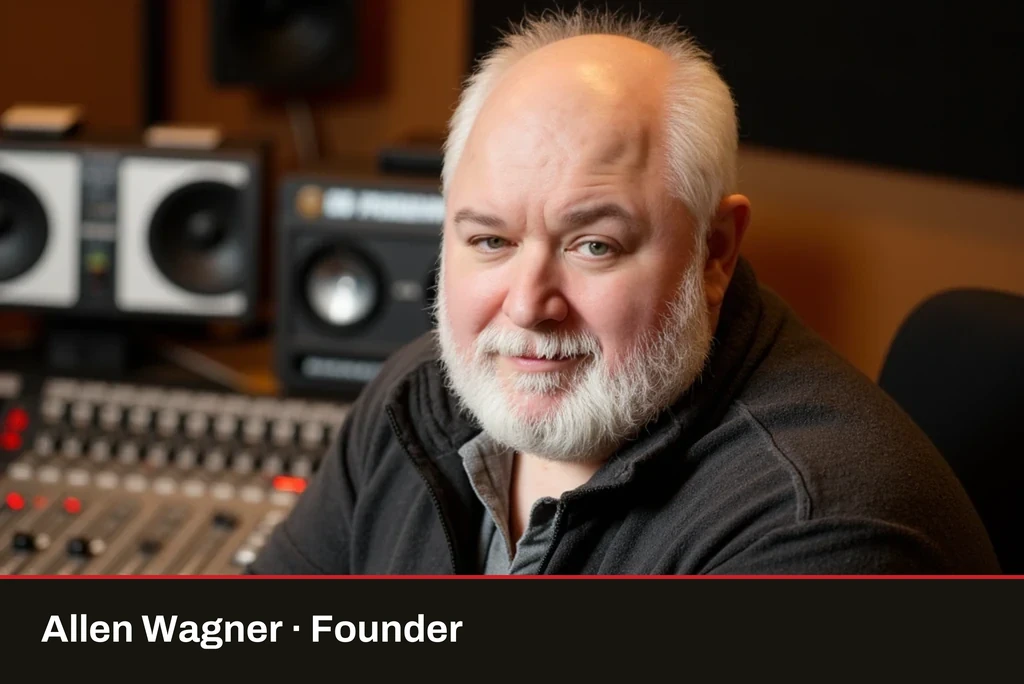
“I'd love to learn about you and your business.”
Ten minutes, and it's mostly me asking what you do, where you do it, and what you've already tried. No pitch deck, no discovery fee, no sales pressure.
Send the form on the rightbelow and I'll set up a call. If we're not a fit I'll tell you right up front and do my best to point you in the right direction.
Call me instead (360) 467-6957