
Get Chosen
Authority Websites
A fifty-page High Performance Authority Site, built to get found and to turn the people who land on it into phone calls. Paid once, and you own it. A 100-300 page build for harder markets.
What you’re actually buying
Fifty pages, not five. That difference is the whole product.
Most local business websites are five pages: home, about, services, gallery, contact. They exist so that a business can be said to have a website. They rank for the company name and almost nothing else, and when a careful buyer lands on one there’s nothing there to read, so they leave and check the next name on their list.
Fifty pages is a different object. That’s a High Performance Authority Site. It has a page for every service you offer rather than a list of them. It answers the questions people actually type. It gives a cautious buyer something to look through, and it gives the machines that now sum up businesses something to quote. This is the piece of the deciding stage that keeps working after you stop paying anybody, because you own it outright.
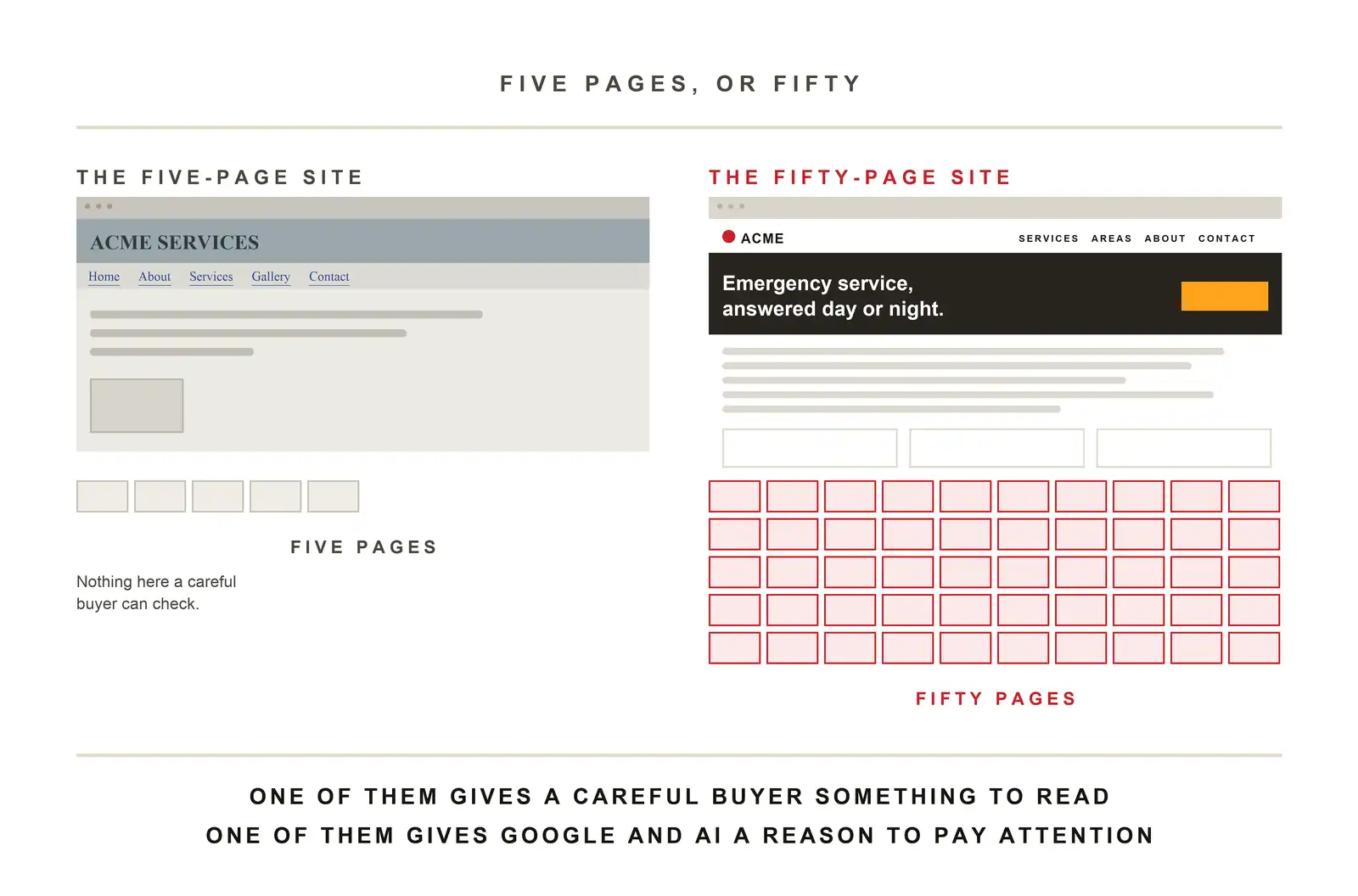
The arithmetic is the argument
We price these by the page, at one flat rate. The rate doesn’t move with the size of the job. When you have the number, divide it by the page count, then call anybody else and ask what a page costs. We’d rather you did.
The hundred-page build works out to the same rate per page. What changes is the size of the job, not the rate, and if we ever quote you something that doesn’t divide out evenly, you should ask why.
Why page count isn’t a vanity number here
A five-page site can only be found by people who already know roughly what to search for. Every additional real page is another question answered, another way in, and another thing a machine can cite when somebody asks it who to call. That only holds if the pages are real. Fifty thin pages are worse than five good ones, and the reason this takes work is that each page has to be worth landing on.
Almost nothing on these pages is there because it looked good. The testing behind how they’re built is set out here, including the parts that disagree with how most websites get made.
Before anybody designs anything
The real work starts before a page is drawn.
Ask for a website and you’ll usually be asked what you want it to look like, which pages you want, and whether you have a logo. Those are reasonable questions and they’re all about the object rather than the job it has to do.
The part that decides whether a site works happens earlier, and design doesn’t come into it:
- What your customers actually type. Not what the trade calls it. The real questions, in their words, taken from what people are searching and asking in your market right now.
- Who’s buying, and what starts them looking. The moment the search happens, what they’re afraid of, and what makes them pick one business over the other two they found.
- What’s already ranking, and what it would take to outweigh it. This is what decides whether fifty pages is enough or whether you need a hundred, and it’s a finding rather than an opinion.
- What people say about your line of work when nobody’s selling. The complaints, the costs, and the exact words customers use about businesses like yours, which is where a lot of the copy comes from.
- A page plan, written before a word of the site is. Which pages exist, what each one is for, and what it answers that no other page does.
That last one has a practical edge. Pages built without a plan end up competing with each other for the same customers, and the usual symptom is a site with plenty on it that still doesn’t rank for anything. Planning it out front costs less than untangling it later.
This is a different job from web design
A web designer’s job is to produce a website, and a good one produces a very good website. That’s not a criticism, it’s the trade. It’s the same reason you wouldn’t ask a framer to do your wiring: the work is real, it’s just a different job.
What you’re buying here isn’t the drawing. It’s the research underneath it, and the fact that every page exists for a reason somebody can tell you.
What it’s built to do
Two jobs, and it fails if it only does one.
Get found
The pages are built so people looking for what you do can find them, and so the answer engines that increasingly stand between a customer and a phone call have something specific to work with. This is where the page count earns its keep.
Turn visitors into phone calls
Your phone number is reachable on every screen without hunting. There’s a form at the bottom of every page rather than buried on a contact page. It loads fast enough on a phone in daylight, which is where most of your buyers are.
That second one is the part that gets skipped by people selling websites, because it’s invisible in a portfolio. A site can look extremely good and produce nothing, and you’d have no way of telling which kind you bought until months later.
What’s actually on fifty pages
- A page for every service you offer, written properly, rather than a bulleted list of them on one page.
- A page for the questions people ask before they hire: what it costs, how long it takes, what goes wrong, what to check before you call anybody.
- Pages for the places you work, where that’s genuinely different rather than the same page with the town swapped out.
That last distinction is where most large websites go wrong and it’s worth being blunt about: fifty near-identical pages with a place name changed isn’t fifty pages, it’s one page repeated, and it works about as well as that sounds. Every page here has to have something on it that’s not on the others.
Built to be read on a phone in a driveway
Your customer isn’t at a desk. They’re standing outside with one hand free, in daylight, deciding whether to call you. Type is large, contrast is high, the phone number is always reachable, and nothing important hides behind a menu. That constraint drives more of the design than anything aesthetic.
Accessibility isn’t optional for some of you
If you’re a law firm, a medical practice, or anybody serving the public in a regulated way, an inaccessible website is a real exposure, not a nice-to-have. The international standard is published openly and it’s what accessibility claims get measured against. Ours is built to it as a matter of course rather than as an upsell.
If your clients don’t search in English
A translate button isn’t a second-language website.
A widget that rewrites the page in the browser doesn’t create anything Google can find. There’s still one page, in English, at one address. The translation happens after it loads, on the visitor’s screen, and it leaves nothing behind to index. Somebody searching in Spanish never reaches it, because as far as search is concerned it was never there.
It also reads like what it is. Machine phrasing is obvious to a native speaker inside a sentence or two, and what it signals is that nobody at this firm actually speaks their language. For somebody already worried about being taken advantage of, that’s worse than a page in English would have been.
What we build instead
Real pages, written rather than translated, at their own addresses. Their own titles, their own descriptions, indexed on their own. A person searching in Spanish finds a Spanish page and lands on it, which is the entire point and the one thing the widget can’t do.
It’s a search problem as much as a language problem. The words people use aren’t translations of the English words. Nobody searches the Spanish for “immigration attorney near me”. They search what they’d actually say, which is often the number of a specific form or a description of the situation they’re in. So the keyword work gets done again, in that language, by somebody who speaks it. Running the English list through a translator produces phrases nobody types.
Where it matters, and one condition
Immigration is the clearest case. It isn’t the only one. In a lot of markets the person searching after a workplace injury or a car accident is a family member rather than the client, and plenty of trades serve a customer base that shops in two languages.
The condition is worth saying plainly, because it decides whether any of this is a good idea. If you publish in a second language, somebody has to be able to answer in it when the phone gets picked up. Pages that invite a call you can’t take are worse than no pages at all, and that’s a staffing question rather than a website one. We’d rather ask about it first than find out afterward.
You don’t mirror the whole site. You pick the pages that carry the decision, usually the practice areas and contact, and leave the rest in English.
What it costs
Paid once, and you own it.
Command Center Website
Mission Control Website
Separate from search work. Buy it on its own if you like, though the hosting rides with Search & Rescue SEO rather than with the build.
What that buys, against what it usually buys
The left column is what the market publishes, not what we think of anybody. Those are the figures you’ll find quoted on the first page of results for what a small business website costs, and the three-to-seven page count and the “you provide the text” line come from the same sources. We’re not saying anyone is overcharging. We’re saying count the pages and ask who writes them.
Fifty pages, or a hundred?
Fifty is the right size for most local businesses. One page for every service you offer, the questions people ask before they hire, and the places you work. In an ordinary market that’s more than anybody you’re competing with has, and it’s enough to be found.
A hundred (or more) is for markets where fifty won’t outweigh what’s already there. You know if you’re in one: the businesses ranking above you aren’t one-person operations, they’ve been at this for years, and their sites are already deep. Personal injury in a big city is one of these. Roofing in a town of forty thousand isn’t.
We’ll tell you which one you need, and the answer’s fifty more often than it’s a hundred. The easiest money in this industry is selling you the bigger build for a market that doesn’t need it, and it’s the fastest way to be wrong about you.
The honest answer is that the number gets settled while the work is happening, not in the quote. The Tidy Sister below started as a fifty-page build and finished at eighty-five, because the further in we got the more there was that was worth covering. We didn’t charge her for the difference. The size follows what the market turns out to need, which isn’t something anybody can know precisely on day one.

The Tidy Sister · house cleaning, Gresham, Oregon
An eighty-five page build, up from fifty. See the site
What happened after it launched

Legacy Tree Care · commercial tree service, Plano, Texas
A hundred-page build. See the site
It’s yours
The site belongs to your business, not to us. This matters more than it sounds like it should: a great many owners discover, at the exact moment they want to leave an agency, that the agency owns the website, the ad account and the tracking number, and that leaving means starting from nothing. We’ve been involved in a lot of those moves and some of them are horror stories. We don’t build that trap and we’ll help you out of one if you’re in it.
Hosting, and the part that keeps it alive
Enterprise-grade hosting is included at no extra charge, for as long as you have Search & Rescue running with us. The plain version: the site lives somewhere serious, and somebody is actively looking after it. That second half is the part nobody mentions when they hand over a finished website.
Kept current
The software underneath it is kept current, both the server and the site’s own working parts. Most sites that get broken into were running something a year out of date.
Backed up three ways
It’s backed up every week, three times over. One copy stays on the server and two more go to separate commercial storage services that have nothing to do with each other or with us.
If somebody breaks in
We clean it up and put back whatever they damaged. It happens to ordinary local businesses far more often than owners think, and it’s worth knowing that the better the rest of this works, the likelier it gets. The more popular you become the more visible you become, and the more visible you become the bigger a target you are. That’s just life on the internet.
Back inside fifteen minutes
A broken site is usually back and working in under fifteen minutes. That’s what three copies in three places buy you, and it’s the difference between a bad morning and a bad month.
If the search work stops, the hosting stops with it. You can buy a hosting package from us and carry on exactly as you were, or your next team can move the site to whatever host they prefer. It’s your site either way, and it goes where you tell it.
When not to buy this
If you have a site that’s genuinely current and your problem is that nobody’s finding it, this is the wrong purchase. Buy the work that gets it found instead and keep your money. We’d rather sell you the less expensive thing that fixes your actual problem.
But “current” is doing a lot of work in that sentence
A site can look perfectly fine and still be unable to compete, and that gap has widened in the last couple of years. What decides whether you get found is no longer only how a page looks. It’s whether the structure and the content are clear enough to be read, sorted and quoted by something that isn’t a person.
A search engine has always needed that. An answer engine needs it more, because it isn’t ranking a list for somebody to browse, it’s assembling a short answer and choosing who to name in it. Five vague pages give it nothing to work with. That’s not a design problem and no amount of restyling fixes it.
So if your site is more than a few years old, it was probably built for a job that has since changed. Not badly built. Built for the search of the time, before any of this mattered.
Check it yourself, because we sell websites
We have an obvious interest in telling you that yours needs replacing, so don’t take our word for it. Four things you can check in ten minutes:
- Does every service you sell have its own page, or are they all listed on one?
- Pick a question a customer asks you every week. Is the answer anywhere on your site?
- Open it on your phone, outside, in daylight. Can you read it and find the number?
- Ask a chatbot who it would recommend for your trade in your town. See whether you come up, and see what it says about you if you do.
If those go badly, a rebuild is worth more to you than another month of ads. You buy it once, you own it, and it keeps working after you stop paying anybody. That’s a different shape of spend from a monthly fee, and it’s the reason we put it in front of search work rather than behind it.
What you end up with.
A site you own, that has enough on it to be found, that answers the questions your buyers actually ask, and that makes calling you the easiest thing on the page. No monthly fee attached to it and nothing holding you to us afterwards.
The first month of working with us buys you that, rather than a strategy document. That’s the difference we’d point at if you’re comparing us with anybody else: ask what exists at the end of month one, and ask whether you can look at it on your phone.
Frequently Asked Questions
The things worth asking before you buy.
What does the fifty-page build actually include?
Fifty pages, written, built, and set up to be found. Not a template you fill in and not a shell waiting on your text. The most common thing a website quote leaves out is the writing, and it's the part that takes longest and decides whether the site works.
Read more on this topic: what the website price includes
Who writes the content?
We do, all fifty pages. "You provide the text and images" is the standard line in this industry and it's where most builds stall. A site half-written for eight months isn't a cheap site, it's no site.
How long does it take?
Live by day thirty, and the only thing that reliably slows it down is waiting on you. Access, your logo, the details only you know. We chase those harder than most because billing is monthly in advance and a month spent waiting is a month you paid for and didn't get.
Read more on this topic: What the first month looks like, day by day
I already have a website. Do I need a new one?
Possibly not, and we'd rather say so. If your site is genuinely current and the problem is that nobody's finding it, keep it and buy the work that gets it found instead. That's the less expensive thing and it fixes the actual problem.
Read more on this topic: The work that gets a site found
Do I own it?
Yes, from day one, and it's registered to your business rather than to us. A great many owners discover at the exact moment they want to leave that the agency owns the site, the ad account and the tracking number. We don't build that trap.
Read more on this topic: Getting out of an arrangement like that
Can I make changes myself?
Yes. It's your site and you get the keys. Most owners want to change a price, a service, or the hours, and that shouldn't need a phone call to anybody.
Why fifty pages instead of five?
Because a five-page site has nothing for somebody checking you out, and nothing for the machine now answering on their behalf. One page per service, one for each question people ask before they hire, one for each place you work. That's fifty without padding, and it's the whole product.
Read more on this topic: why the site is fifty pages
Do you host it?
Yes, and it's included for as long as Search & Rescue SEO is running. Enterprise-grade hosting, the software kept current, weekly backups in three places, and a break-in cleaned up if it happens. It isn't part of the one-time build, and if the search work stops you can buy a hosting package or take the site anywhere you like.
What if I leave?
The site is yours and it goes with you. What doesn't follow is the hosting, because that rides with the monthly search work rather than the build.
Read more on this topic: What you keep if you go, and what you don't
Can't we just add a translate button?
It won't do the thing you're buying it for. A widget translates the page in the visitor's browser after it loads. There's still one page, in English, at one address, and nothing new for Google to index, so somebody searching in Spanish never arrives in the first place.
It also reads like machine text to anybody who actually speaks the language, which is the opposite of the signal you're paying for. Pages written in that language, at their own addresses, are a different product and the only one that gets found.
Book a call
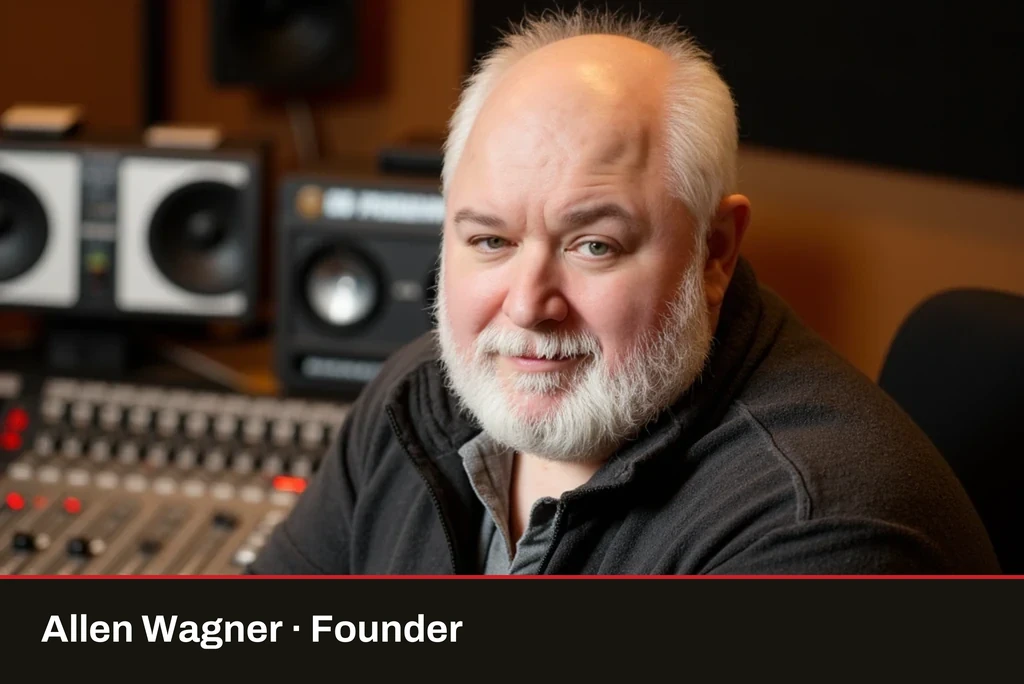
“I'd love to learn about you and your business.”
Ten minutes, and it's mostly me asking what you do, where you do it, and what you've already tried. No pitch deck, no discovery fee, no sales pressure.
Send the form on the rightbelow and I'll set up a call. If we're not a fit I'll tell you right up front and do my best to point you in the right direction.
Call me instead (360) 467-6957