
Get Chosen
First Response
Nobody reaches your voicemail. Every call gets answered, the details get taken, and you get told immediately.
The most expensive thing in your business
A missed call doesn’t show up anywhere, which is why it never gets fixed.
Every other problem in a business announces itself. A truck breaks down and you know. A job goes wrong and somebody tells you. A missed call is silent: somebody calls, gets four rings and a voicemail greeting, and hangs up without leaving a message. Then they call the next name on the list, and hire whoever picks up. Nothing about that appears on any report you’ll ever see, and there’s no month where you sit down and notice it happened eleven times.
That’s what makes it different from everything else on this site. It’s not that owners don’t care about missed calls. It’s that the loss is invisible, and invisible losses don’t get budgeted for. This is the third piece of what decides which of three businesses gets called, and it’s the one that quietly costs the most.
Voicemail isn’t a safety net
Somebody with a burst pipe isn’t leaving a message and waiting. They’re working down a list, and they stop at the first business that answers. If you’re third on that list and the first two send them to voicemail, you win a job you did nothing to earn, and the reverse happens to you just as often, without you ever knowing.
The worst time is exactly when you can’t answer
The calls come while you’re up a ladder, under a sink, in a hearing, or driving between appointments. Which means the busiest month, the one where you most need next month’s work lined up, is the month you answer the fewest calls.
It’s the same trap as the empty month, in a different place. The work you already have is what stops you catching the work that’s trying to reach you.
What you get
Every call answered. Every message on your website answered too.
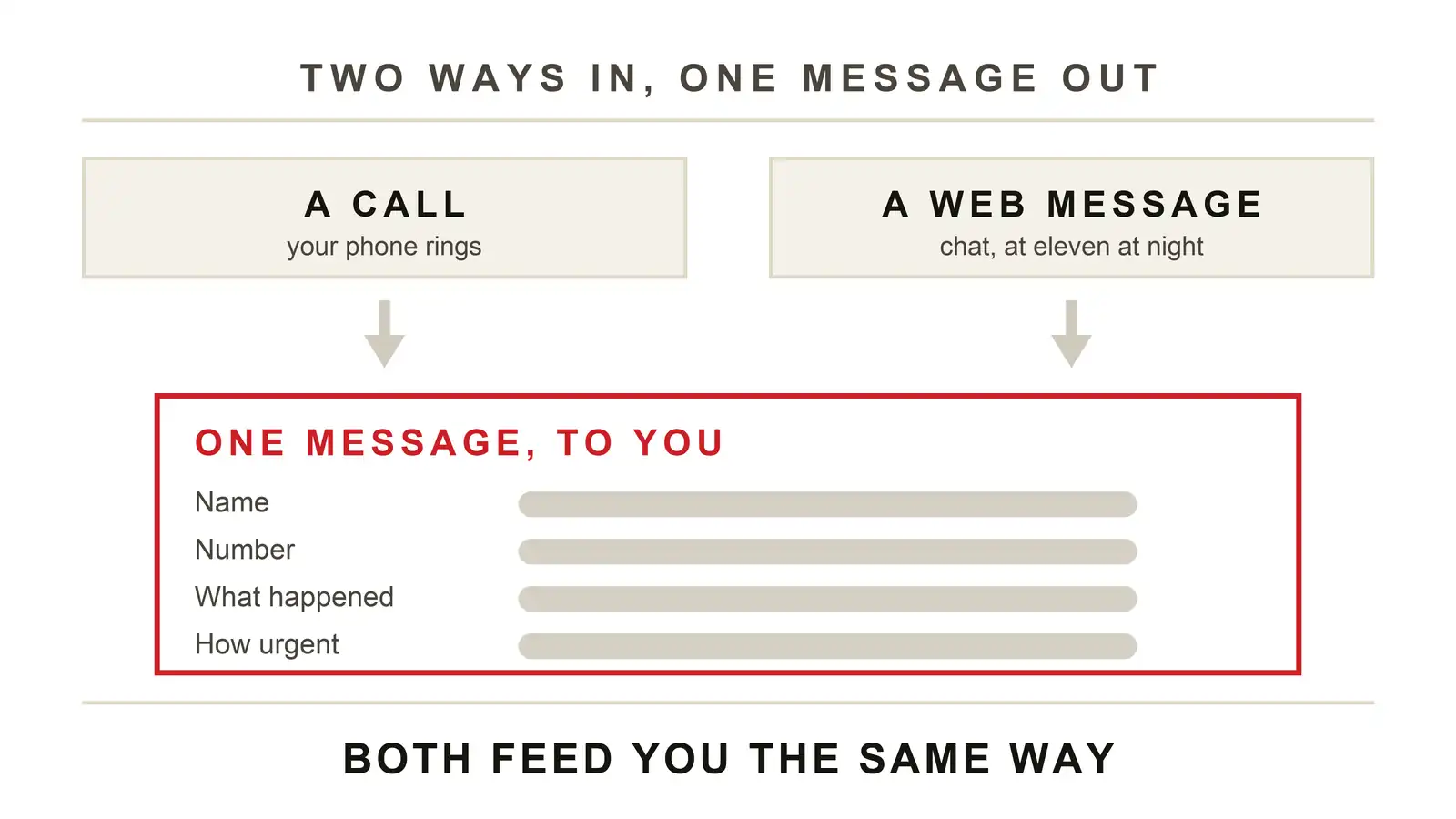
An AI agent picks up your phone when you can’t. It’s open 24/7, nights, weekends and holidays included. It answers in a normal voice, asks what the problem is, takes the details you need taken: name, number, address, what has happened, how urgent it is, and sends them to you immediately, while the person is still thinking about you rather than dialing somebody else.
The same thing runs on your website as a chat window, for the people who would rather type at eleven at night than call anybody. Both feed you the same way.
Say the word AI out loud, because we’re going to
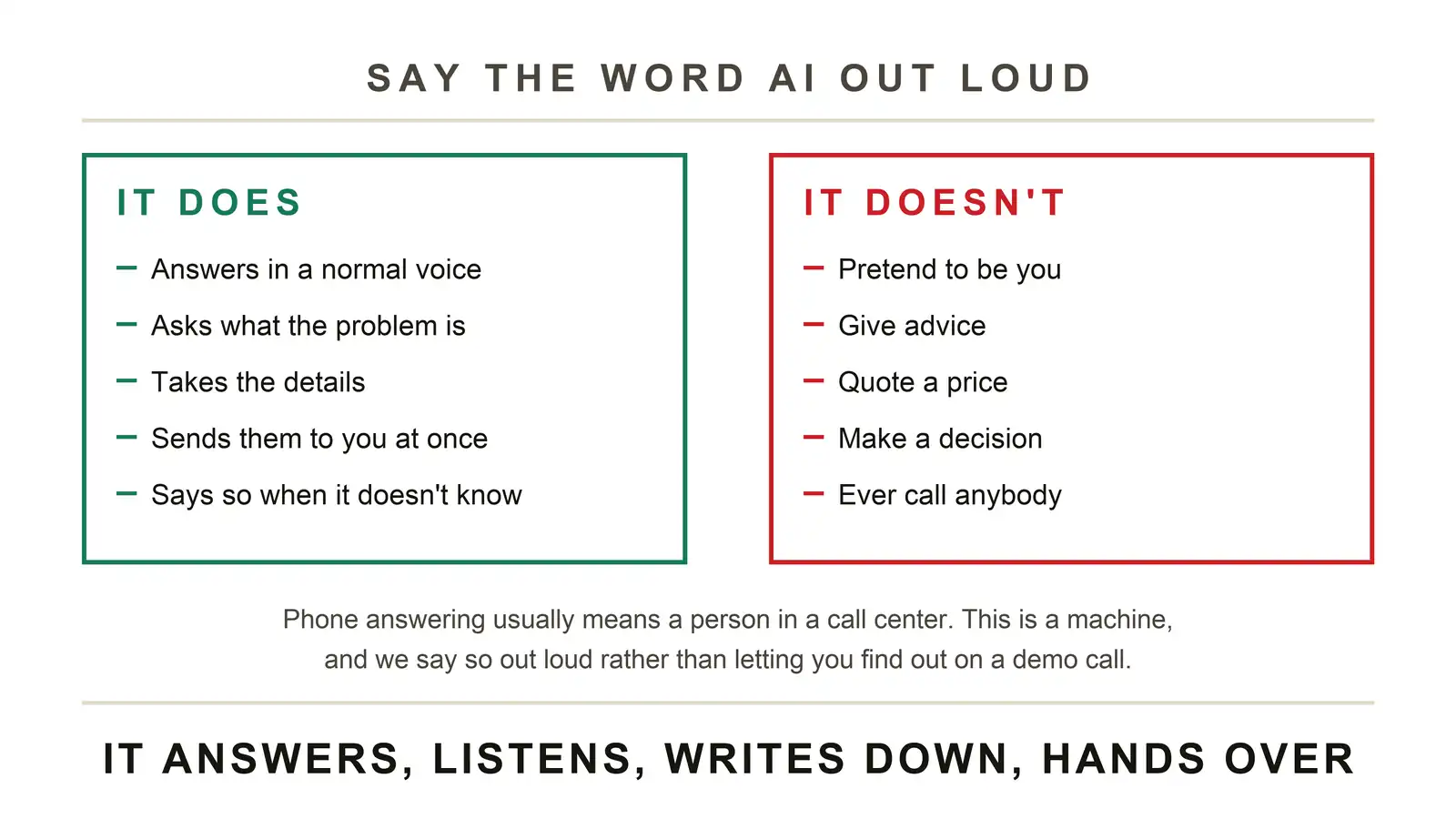
Phone answering usually means a person in a call center. This isn’t that, and we’re not going to let you find out on a demo call. It’s a machine, it costs a fraction of what a human answering service costs, and that’s precisely why it’s affordable at this price.
What it doesn’t do is pretend to be you, give advice, quote prices, or make decisions. It answers, it listens, it writes down, it hands over. For a law firm, and this is the question every attorney asks first, it never discusses a matter, never offers an opinion, and never talks to a distressed caller as though it were counsel. It takes the details and gets you on the phone.
What actually reaches you
A message, immediately, with the caller’s name, their number, what they said the problem was and how urgent it sounded. Not a recording you have to sit through and not a transcript of small talk, the details you’d have written on the back of an envelope, in the order you’d have written them.
You decide what happens next. Most owners call back within the hour, which we see in our own accounts, and that’s enough, because the caller has already spoken to your business rather than to a beep. The job of this isn’t to replace you on the phone. It’s to make sure that by the time you call back, they’re still there to answer.
What it has to be taught
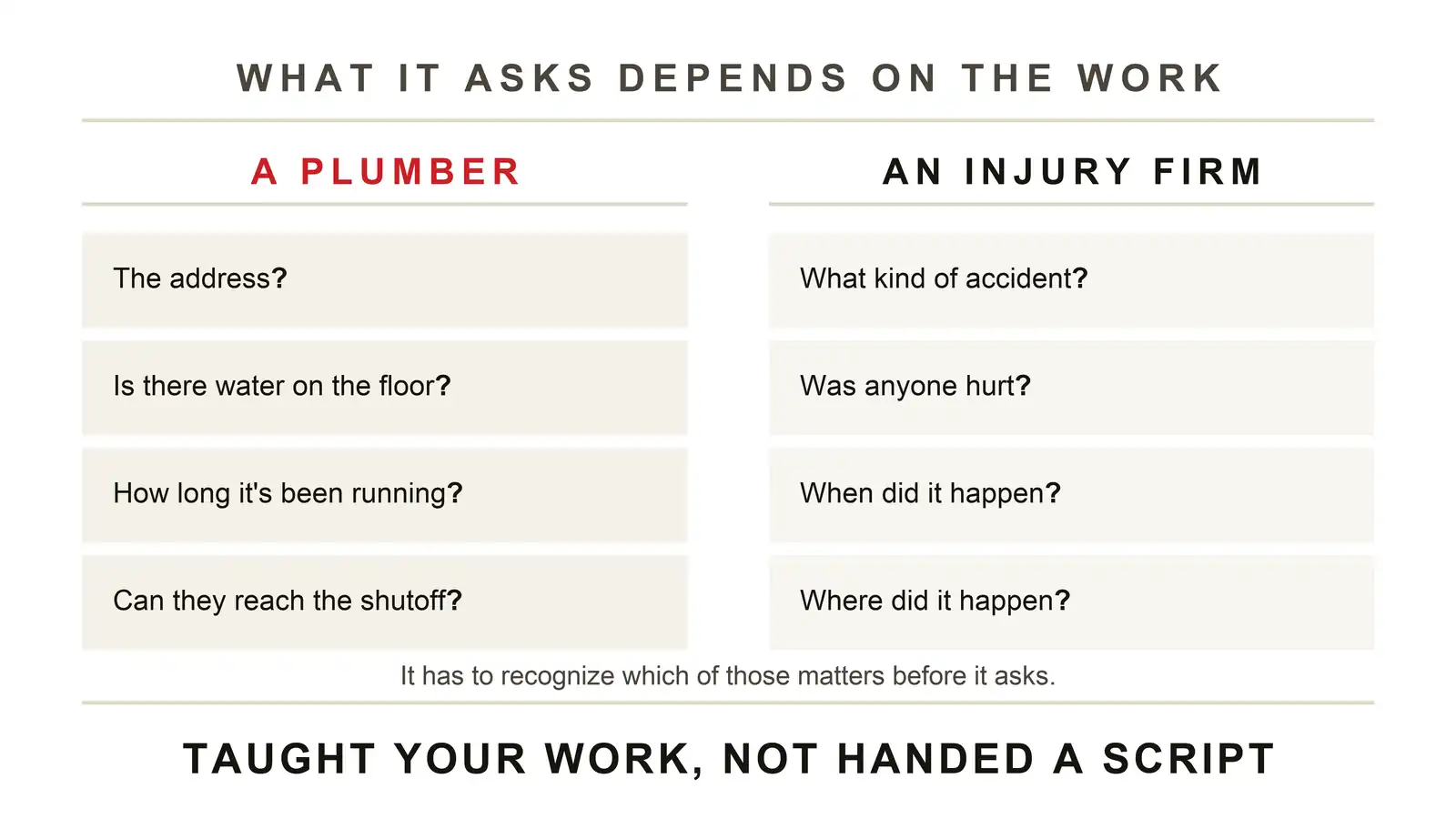
What it needs to ask depends on what you do. A plumber needs the address and whether there’s water on the floor. A personal injury firm needs to know what kind of accident it was, whether anyone was hurt, and when and where it happened, and it has to recognize which of those matters before it asks. The receptionist is taught your work and the kinds of matters you take, and that’s most of what separates the bottom of the price from the top.
Inbound only
It answers calls. It doesn’t make them. We don’t use AI voice for outbound calling of any kind, and if that’s what you’re looking for, we’re not the people.
How it reaches your phone
Your number stays your number. Nothing is ported, nothing is transferred, and the number on your van, your cards and your listing stays right. What changes is what happens when that number rings and nobody picks it up.
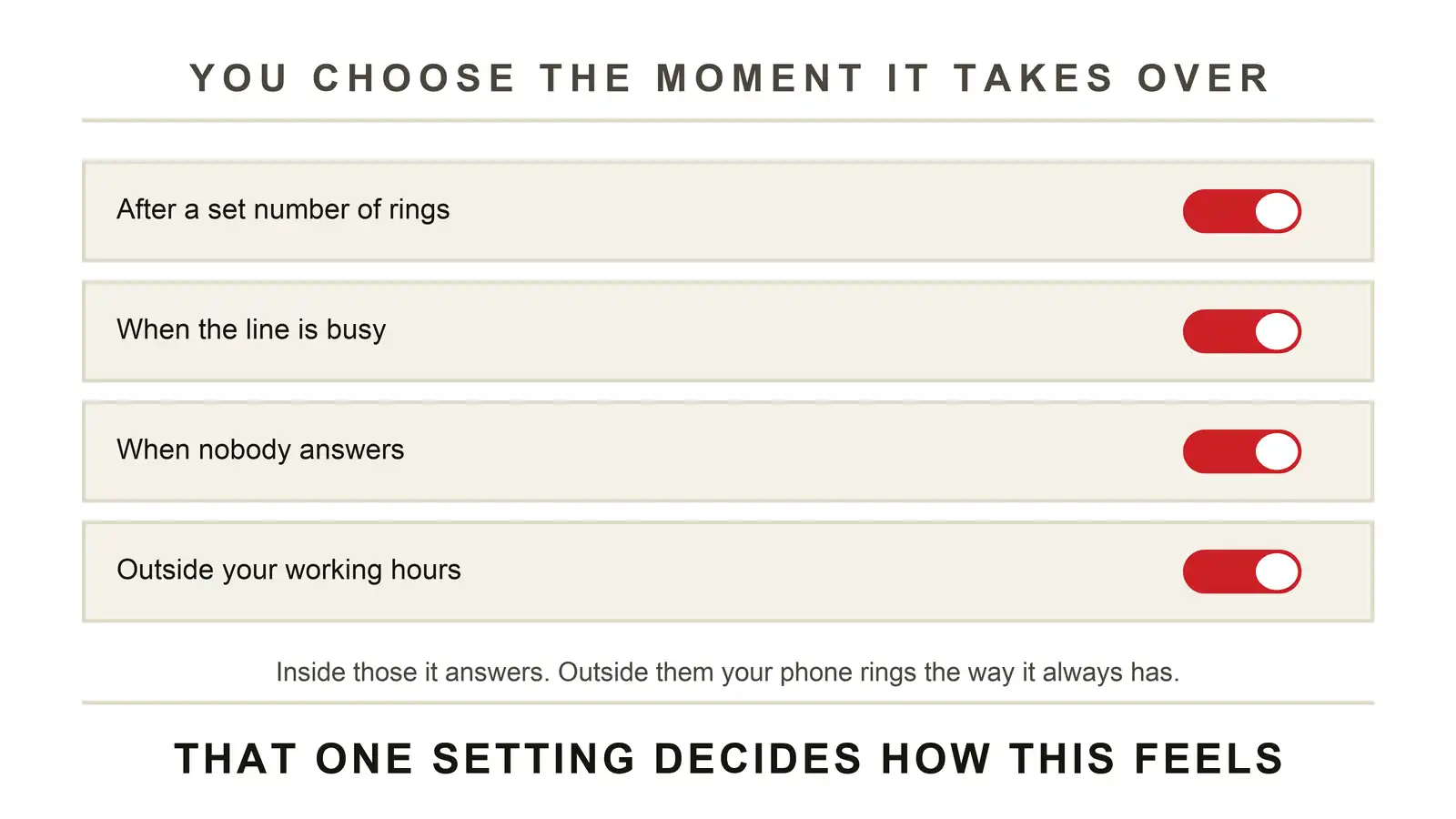
You choose the moment it takes over. After a set number of rings, when the line is busy, when nobody answers, or outside your working hours. Inside those conditions the call goes through; outside them your phone rings the way it always has. Turning it off again takes minutes.
That one setting decides how this feels. Too few rings and it answers calls you’d have taken yourself. Too many and the caller has already given up. It’s worth choosing deliberately rather than accepting whatever it arrives set to.
What happens when it doesn’t know
It says so, and takes the question anyway. Something specific about your business it wasn’t told, a job that genuinely needs seeing before anybody can price it, a caller asking sideways. The answer in all three cases is the same: admit it, capture what they actually said, and tell them when somebody will call back.
This is a design decision rather than a limitation. A system like this can produce a confident answer to almost anything, which is the problem. A guess about your price is a quote somebody will hold you to, and a guess about your calendar is a promise somebody has arranged their day around. You find out when they’re annoyed rather than when it was said.
Urgency is treated separately from knowledge. Not knowing the answer and recognizing that somebody is standing in water are different jobs, and it can do the second while failing the first. Where the line falls between an emergency that reaches you at eleven at night and a quote that waits until seven is yours to set, and it’s the most important thing decided at setup.
What it costs
Quoted once we’ve looked.
What it costs depends on how many calls you get, how long they run, and how much the receptionist has to know to handle them properly, so a bigger or more complicated operation costs substantially more: a multi-partner law firm, for example, or a company running several crews. There are also a few optional extras that add a small amount if you want them. You’ll know which applies to you before you buy anything.
First Response
Compare it to what one missed job is worth, not to what a phone line costs.
The comparison that matters
Don’t weigh this against your phone bill. Weigh it against one client. If one new client is worth two thousand dollars to you, this pays for itself on one recovered call every seven months. If it’s twelve thousand, the math stops being a discussion. The question isn’t the price, it’s how many calls you’re currently missing, and neither of us knows that number yet, which is itself the argument.
When it won’t help you
If you don’t answer your phone because you’d rather not, this changes nothing, it just means a machine takes a message you also won’t return. This only works for people who want the calls and can’t physically get to them.
More people reach you, without one more finding you.
The number of people who reach your business goes up without a single extra person finding you. That’s the whole argument for it, and it’s why we usually raise it before we raise anything that costs more.
You’ll also, for the first time, be able to see the size of the problem you had, because every call that would have gone to voicemail now arrives as a message with a name and a number attached to it. Most owners find that first month uncomfortable reading, and missed calls turn out to be the least of it.
Over the years we’ve listened to a lot of recorded calls. We’ve heard front desk staff send a caller to a competitor. We’ve heard owners answer their own phone so abruptly that the caller assumed they’d reached the wrong number and hung up. Nobody in those calls was doing anything malicious, and not one of them showed up on any report.
We run this on our own phone, and we measured it before and after. Voicemail was losing nine callers in ten. With the agent answering, under one in ten hangs up. That’s our line rather than a promise about yours, and it’s the reason we sell this at all.
Frequently Asked Questions
The things worth asking before you buy.
Why does this cost more than the AI receptionists I've seen for $25 a month?
Because the cheap tiers are priced on minutes, and minutes are the thing you can't predict. Entry plans cap you somewhere between twenty and a hundred and fifty minutes a month. Go over and the overage runs at a rate per minute that turns a twenty-five dollar plan into a mid-tier bill in the month you actually get busy.
The other half is what happens around the call. Setup fees, minimum commitments, and billing that counts the time spent writing up the call as well as the time talking. We don't do any of that, and the point of the price is that it's the price.
Read more on this topic: what the cheap answering plans actually cost
Is it a robot? Will people know?
Some will, and it matters less than you'd think. What a caller notices is that somebody picked up on the second ring at seven in the evening and knew what you do. The alternative isn't a person, it's a voicemail they won't leave.
Read more on this topic: whether callers can tell it's AI
What happens when it can't answer their question?
It takes the details and hands them to you rather than guessing. The failure people worry about is a machine inventing an answer about pricing or availability. The design goal is the opposite: capture who called, what they need, and how to reach them, then get out of the way.
What about after hours and weekends?
That's most of the value. The calls you lose aren't usually the ones during business hours, they're the ones at six on a Friday and mid-morning while you're under a sink. Those callers ring the next business on the list rather than leaving a message.
Does it book appointments, or just take messages?
Both are possible and they're different jobs. Taking a message reliably is the floor. Booking into a calendar means the calendar has to be right, which is a decision about how you run your week rather than a feature question. We'd rather set up the first properly than the second badly.
Read more on this topic: whether it books appointments
Is it legal to use AI to answer my phone?
Yes. Answering a call somebody chose to place to you isn't regulated the way outbound marketing is. The rules people have read about, the ones requiring written consent before a call, apply to marketing calls you make. They don't reach a business answering its own line.
Do I have to change my phone number?
No. Your number stays your number. What changes is what happens when it rings and nobody picks up.
What if I get more calls than I can handle?
That's worth thinking about before you buy, not after. Marketing makes a working business busier, and a business already at capacity gets a bigger problem rather than a better month.
Read more on this topic: When we're the wrong call
Am I locked into anything?
No term, no setup fee, and no notice period. Tell us and it stops at the end of the month. Search is the only service here that asks for notice, and this isn't it.
Read more on this topic: What happens before any money changes hands
Book a call
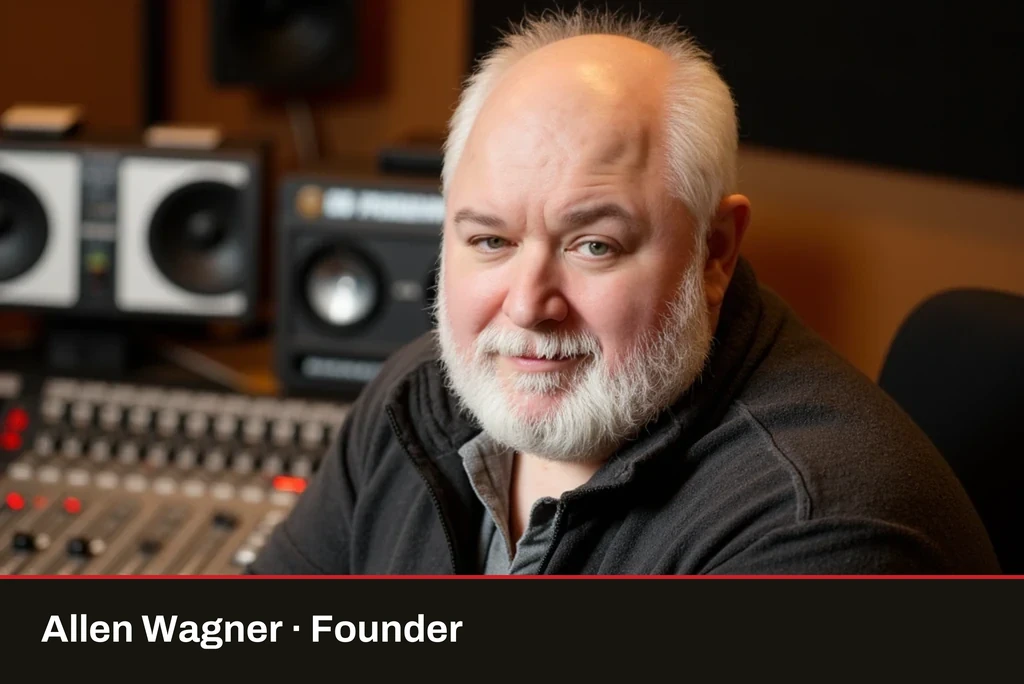
“I'd love to learn about you and your business.”
Ten minutes, and it's mostly me asking what you do, where you do it, and what you've already tried. No pitch deck, no discovery fee, no sales pressure.
Send the form on the rightbelow and I'll set up a call. If we're not a fit I'll tell you right up front and do my best to point you in the right direction.
Call me instead (360) 467-6957