
Get Found
Search & Rescue
Own the map in your market, and be the one the AI names when somebody asks it instead of searching.
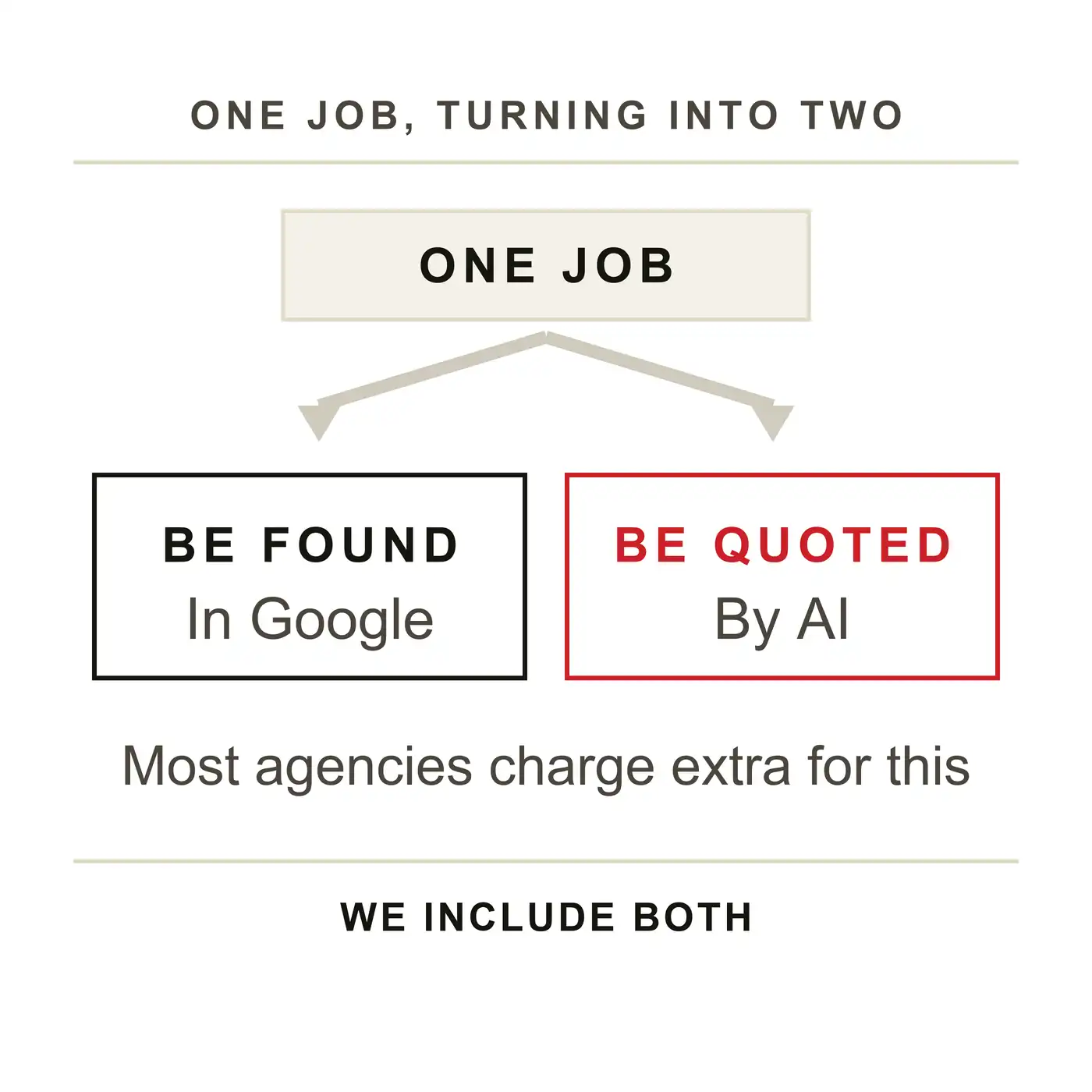
Two things, sold as one
These used to be one job. They’re turning into two.
Most agencies are still charging for the first and adding the second as a line item later. We include both, because a customer who asks a chat window who to call hasn’t done anything unusual, they’ve just skipped the step everybody used to take. This is the long half of getting in front of people, the half that keeps paying after you stop.
The map listing isn’t your website
For most local businesses it produces more calls than the website does, and it’s a separate thing with separate rules. We’ve watched that in client analytics for years, including a good share of callers who never land on the website at all. The person searching the map has already decided to hire somebody local, and all that’s left is which one. That’s a different visitor from the one who wandered onto your website and may be an hour or a year from doing anything. Categories, service areas, hours, photographs, questions, and its own reviews. It can rank beautifully while your website ranks nowhere. Plenty of businesses have spent a year and real money on a website while the listing that generates their actual phone calls sat half-completed with a category somebody picked in a hurry years ago.
First in one spot, invisible in the next
Map rankings are worked out from where the searcher physically is, so your coverage is a shape on a map rather than a position on a list. A business can hold the top spot in its own parking lot and not show up at all a few blocks away in any direction. That’s normal, it’s how the map works, and it’s why “you’re number one” is an incomplete sentence until somebody says where.
It’s also what the work is for. Widening the area you show up across is a different job from moving one number, and it’s measured by how much of your market can see you rather than by a position you checked once from your own desk.
Which is worth saying plainly: checking yourself on your own device is the least accurate way to see how you rank. You’re at the address where you do best, on a phone that’s signed into your account and has been to your site more than anybody else’s. Both of those tilt the result your way. The number that matters is what a stranger sees from the other side of your market, and that isn’t something you can check by searching your own business over a coffee.
How far your reach goes, and how it grows
For most businesses that shape runs somewhere between three and seven miles out from your address. How far depends on where you are. Dense towns are tighter, spread-out ones reach further, and a competitor sitting between you and a neighborhood will cost you that neighborhood.
Widening it is most of the ongoing work, and it’s the part that keeps paying long after the first month is done. Every street that comes inside your shape is people who couldn’t see you before and can now.
When you run out of room, the next move is another area rather than a bigger radius. If you can genuinely handle more volume, we go and build the same shape around an adjoining town, and that can be repeated for as many areas as you want to take on. It’s the growth path for a business that’s already full where it stands.
The only gate is whether you can take the work. We’d rather hold you at one area that’s producing than spread you across three that are half fed.

Citations are about being verifiable, not about volume
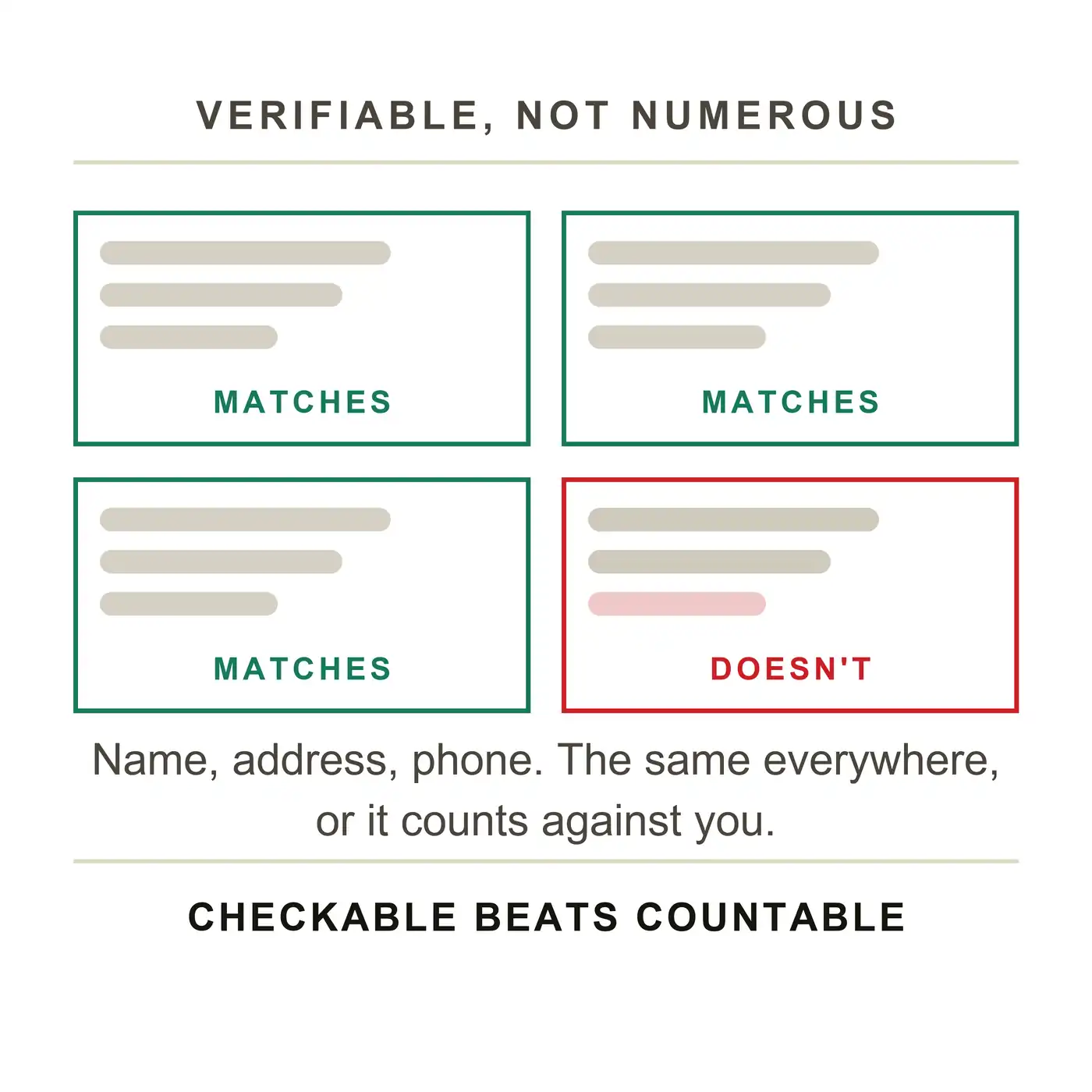
A citation is just your business name, address and phone number listed somewhere other than your own website. The word makes it sound technical. It isn’t. What matters is that the listings agree with each other, because a business whose details say three different things is a business nothing can verify.
Your name, address and phone number appearing consistently across sources that matter is what makes a business checkable. What doesn’t help is a bulk submission to hundreds of directories nobody reads, which is what “citation building” usually means when it’s sold cheaply. A handful of real, relevant listings that agree with each other beats four hundred that don’t.
What off-site work means, in plain terms
Everything that makes your business verifiable somewhere other than your own website. Your details appearing consistently on sources that matter. Being mentioned where businesses like yours get mentioned: professional associations you actually belong to, suppliers you actually buy from, the local paper when you actually do something. A machine deciding whether to recommend you is doing something close to a reference check, and this is the part that either passes or fails it.
What it’s not is buying links, which is the version of this that’s sold cheaply, is against the rules of every search engine, and puts your listing at risk rather than your money. If somebody offers you a package of links at a per-link price, that’s what they’re selling.
Being quotable is the new part
When a machine answers “who should I call about this”, it assembles that answer from what it can read and confirm about businesses. Specific, checkable, consistent information gets used. Vague marketing language doesn’t, because there’s nothing in it to lift. This is the practical reason a fifty-page site outperforms a five-page one for this: there’s simply more to quote.
Most of this is just doing the ordinary work properly. Roughly nine times out of ten, a business that gets recommended by a machine got there because the fundamentals were right: the listing was accurate, the details agreed everywhere they appeared, and the website actually said something specific about the work. There’s no separate trick that skips that part. If somebody offers you one, ask what exactly they’re doing, and watch what happens.
The other tenth is ours, and we don’t publish it. It took years and real money to work out, and writing it down for competitors to read isn’t a service to you. What you can hold us to is the same thing you can hold us to everywhere else on this site: not how the work gets done, but whether the phone rings more than it did before. Ask us that as often as you like.
Gemini is the one that matters most right now
Because it’s what sits on top of Google. Somebody searches the ordinary way, an answer appears above the results, and that’s the thing they read first. A good share of them never scroll past it. Being named up there beats being named in a chat window somebody had to go and open on purpose, so that’s where we push hardest. It also isn’t a side project to the search work. It’s the same work, aimed at the thing now sitting above the results.

It changes every two weeks, and it’s different on every phone
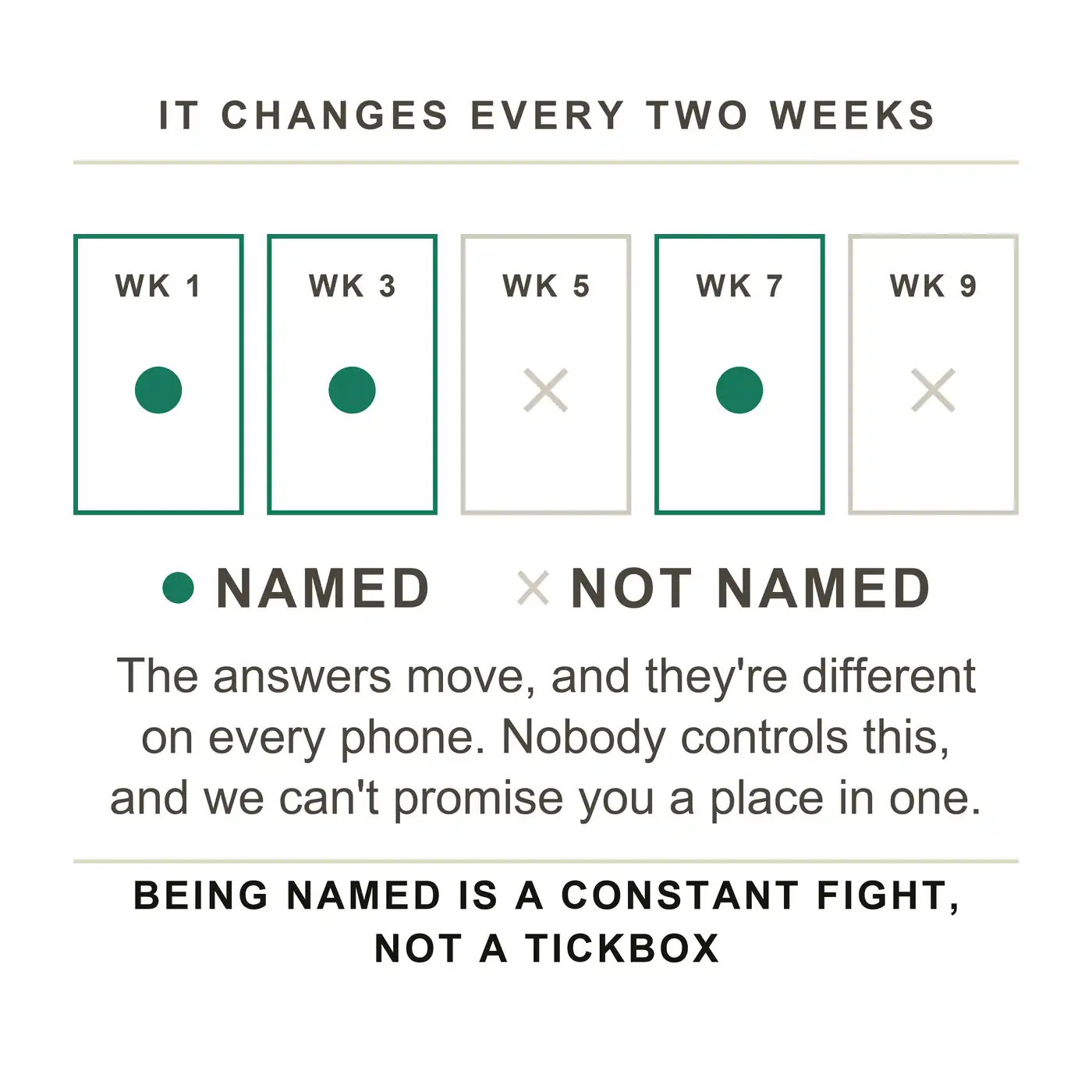
This part is genuinely unsettled, and you should hear that from us rather than find it out. The answers move. Something that named you in the first week doesn’t in the third. And the same question, asked on two phones at the same moment, comes back different, because each one is trying to match the person holding it.
It’s a lot like the early days of the internet, when the rules moved under everybody every few months. Only more scattered, because there isn’t one set of answers to change any more. There’s one per device.
So being named is a fight, and some weeks it’s a daily one. It isn’t a box that gets ticked once and stays ticked. The work is staying on it: watching what the answers say about you, and putting every bit of pressure we have on your business being recognized and recommended as often as possible.
What we won’t do is promise you a place in an answer, for the same reason nobody can promise you a ranking, only more so. Nobody controls what a machine says next week. If you’re told otherwise, you’ve learned something useful about who you’re talking to.
Before you sign anything, with anyone
The guarantee that’s always kept and never worth anything.
The sales call comes in cold. Good news! They guarantee first page ranking, all for just $200 a month on a twelve month contract.
It sounds like the cheapest thing you’ve ever been offered, and plenty of people sign up for it.
And they do rank you. For something like:
“best plumbers who wear blue shirts in Phoenix, Arizona”
Nobody searches that. Nobody ever will. But the guarantee has been met, in writing, and the term runs to the end. Some of these get handed to collections if you stop paying, and an attorney costs more than the year does, so most people pay it out and never trust anybody again. They’re angry every time they make that payment, and we still hear about it years later.
You don’t need to understand any of this to protect yourself. You need one question, and you should ask it of us as readily as of anybody else:
Rank me for what, exactly, and how many people search it?
A business that can’t answer that plainly is either not measuring or not telling you.
So here’s our answer to it
We aim to put you in the top three of the local map pack and keep you there. That’s the block of three businesses that shows above the ordinary results with the map beside it, and it’s where the calls come from. You don’t need to be first. You need to be one of the three.
The one thing we won’t promise is the number one spot, because a position moves with who’s searching and where they’re standing. Anybody selling you number one is selling you a screenshot.
For what, and where, are the two halves that make that mean anything. For what: the things somebody types when they need what you do today, not a phrase nobody searches. And where: a business ranks in a shape around its address rather than everywhere at once, and for most that’s somewhere between three and seven miles out, depending on how tightly Google draws the map where you are.
You’ll know whether it happened without taking our word for it. You count the calls and the contact requests from your website. This takes somewhere between thirty and ninety days to show. If it hasn’t, give us our sixty days’ written notice.
What it costs
Quoted once we’ve looked.
Search & Rescue SEO
Work starts inside 14 days. No month of discovery documents.
Sixty days’ written notice, and why this is the only service that asks for it
Everything else here is month to month. Tell us and it stops. Search is the exception, and it’s worth saying why rather than burying it in the terms.
This work is committed ahead of the month it belongs to. Pages are researched and written weeks before they publish, outreach is arranged with other people’s schedules, and the drip of supporting content is queued out in front of you. By the time a month starts, most of its work is already bought.
The second reason is the one that matters to you. Search is the only thing here that decays when it stops. Reviews you’ve earned stay earned. A website you own stays yours. Ads switch off cleanly and cost nothing the next day. A search position is held rather than built, and a hard stop mid-month wastes work you’ve already paid for. Sixty days lets it be wound down rather than dropped.
You don’t have to give a reason, and there’s no term underneath the notice period. If it isn’t earning more than it costs, the right thing is to tell us in writing, and the sixty days starts then.
The two halves need each other
The map listing and the website aren’t alternatives and working on one without the other wastes most of the effort. A well-built listing sends people to a website with nothing on it, and they leave. A fifty-page website with a half-filled listing never gets found by the people who search on the map, which for most local businesses is where the calls are. They’re worked on together here for that reason, not as an upsell.
The website is hosted and looked after while this runs
Enterprise-grade hosting is included at no extra charge, for as long as Search & Rescue is running. The site lives somewhere serious and somebody is actively looking after it: the software underneath is kept current, it’s backed up every week in three places, and a site that breaks is usually back inside fifteen minutes. What the hosting covers in full is set out on the websites page. If the search work stops the hosting stops with it, and you can either buy a hosting package and carry on unchanged or move the site wherever you like.
Why not three hundred a month?
Because at three hundred dollars a month there’s not enough labor in the budget to do the work. That’s arithmetic, not an opinion about anybody. Whatever is being sold at that price is either automated, outsourced to the cheapest available hands, or simply not happening, and the twelve-month term exists to make sure you find out slowly.
What happens in the first month?
Not a strategy deck. Inside the first fourteen days the map listing gets built out properly, real citations get built, and either your existing site gets worked on or a new one goes up. You should expect to see the phone move somewhere between thirty and ninety days, and for it to keep improving for about six months after that.
That’s faster than the six-to-twelve months the industry usually quotes, which is both what competitors publish and what new clients tell us they were promised, and there’s no trick in it. It’s faster because three things run at once rather than one, ads can ring the phone in days while the search work matures underneath. And there’s no 12-month contract, so if it doesn’t happen you give notice and stop.
How you’ll know.
Not by a position report. By how many calls you got and how many contact requests came in from your website, with spam and sales calls excluded from both.
Search work is the single easiest service in this industry to show a good-looking result for while producing nothing, because every natural measurement it has, where you rank, how many people saw you, how many visited, can improve without one more person ever calling you. That’s exactly why we don’t report on any of them.
Frequently Asked Questions
The things worth asking before you buy.
Could I just do this myself?
Yes, and a fair amount of it you should. Claiming your Google Business Page, keeping your name, address and phone identical everywhere, asking customers for reviews and replying to them: that's real work, it moves the needle, and nobody needs to be paid to do it for you.
What you're buying isn't secret knowledge. It's the hundred hours a year, the part that never gets done in a busy month, and knowing which of the fifty things worth doing matter in your market this quarter. If you've got the time and you'll actually keep at it, do it yourself and keep your money.
Read more on this topic: how much of this you can genuinely do yourself
How long before it works?
Expect the phone to move somewhere between thirty and ninety days, and to keep improving for about six months after that. Inside the first fourteen days the map listing gets built out properly and real citations get built, so there's something to look at well before there's something to celebrate.
Read more on this topic: how long local SEO takes to work
Why does this cost more than the $300 a month I've been quoted?
Because at three hundred dollars a month there isn't enough labor in the budget to do the work. That's arithmetic, not an opinion about anybody. Whatever is being sold at that price is either automated, outsourced to the cheapest available hands, or simply not happening.
It isn't only us saying it. Search for what SEO should cost and you'll find the same warning about anything under about three hundred a month, usually attached to the word "risky".
Read more on this topic: why the cheap monthly packages can't do the work
What decides what this costs for me?
Competition and how much ground you want to cover. A single-location business in a quiet market sits at the lower end. A business fighting several well-funded competitors across a wide service area sits higher, because there's more to build and more to keep holding.
Is any of this still worth it now that AI answers everything?
The job changed, it didn't end. When somebody asks a machine who to call instead of typing it into Google, that machine is reading the same things: your listing, your website, your reviews, and what other sites say about you.
That's why AI search work is included here rather than sold separately. It isn't a different service, it's the same groundwork read by a different reader.
Read more on this topic: whether SEO still matters with AI
What's the difference between the map listing and my website?
They're two different things with two different sets of rules, and for most local businesses the map listing produces more calls. The listing is what shows up on the map when somebody searches nearby. The website is what they check before deciding. Working on one without the other wastes most of the effort.
Read more on this topic: How getting found actually works
Do I need a new website to do this?
Not necessarily. If your site is genuinely current and the problem is that nobody's finding it, keep it and buy the work that gets it found. We'd rather sell you the less expensive thing that fixes your actual problem.
Read more on this topic: What we build when a site does need replacing
How will I know it's working?
By the phone, and you can check it without us. One number, in your own account, that you can look at on your own phone whenever you like. Not a report we send you, and not a dashboard of things that go up while the phone stays quiet.
What happens if I stop?
It slides, slowly at first and then faster. Most businesses are visibly worse off somewhere between six and twelve months after the work stops, depending on how contested their area is. That's the honest reason this is a monthly fee rather than a project, and it's true of any company you hire, not just us.
Read more on this topic: What the first month looks like, and what happens after
Does Google charge for any of this?
No. Creating and keeping a Google Business Page is free. Google will never call you demanding payment to keep your listing active. If somebody rings asking for a monthly fee to maintain your Google listing, that's either a scam or an agency that would rather you didn't know the listing itself costs nothing.
Read more on this topic: The other things sold this way
Book a call

“I'd love to learn about you and your business.”
Ten minutes, and it's mostly me asking what you do, where you do it, and what you've already tried. No pitch deck, no discovery fee, no sales pressure.
Send the form on the rightbelow and I'll set up a call. If we're not a fit I'll tell you right up front and do my best to point you in the right direction.
Call me instead (360) 467-6957