
Law firms
Marketing for Business Law Attorneys
Built on relationships and referral, with an urgent edge nobody markets for: the demand letter, the deal date, the partner who wants out.
Who this is for
Most of it arrives through somebody you know. The rest arrives with a deadline attached.
Business law is the most relationship-driven practice on this list, and that’s genuinely how most of the work arrives: an accountant, a banker, a client who moved on and came back.
Which makes it tempting to conclude that search does nothing here. It isn’t true, and the reason is the same as in estate planning: the referral looks you up before they call.
Then there’s the urgent edge. A demand letter with a date to respond. A closing that has to happen this month. A partner who wants out. An employee threatening a claim. None of those are emergencies, and all of them have a clock.
Why this practice is its own challenge
The referral checks you out, and half of them find nothing.
A business owner given your name doesn’t simply call. They search you, they look at whether the practice does this kind of work, and they decide whether you look like somebody who handles companies their size.
That has three consequences, and each is a marketing problem rather than a legal one.
The referral ends in a search, and often in a list
If they find a real practice, the recommendation holds.
If they find almost nothing, they search generally instead, and you’re suddenly one of three firms with no advantage at all.
That’s the quiet way relationship-driven practices lose work they had already been given.
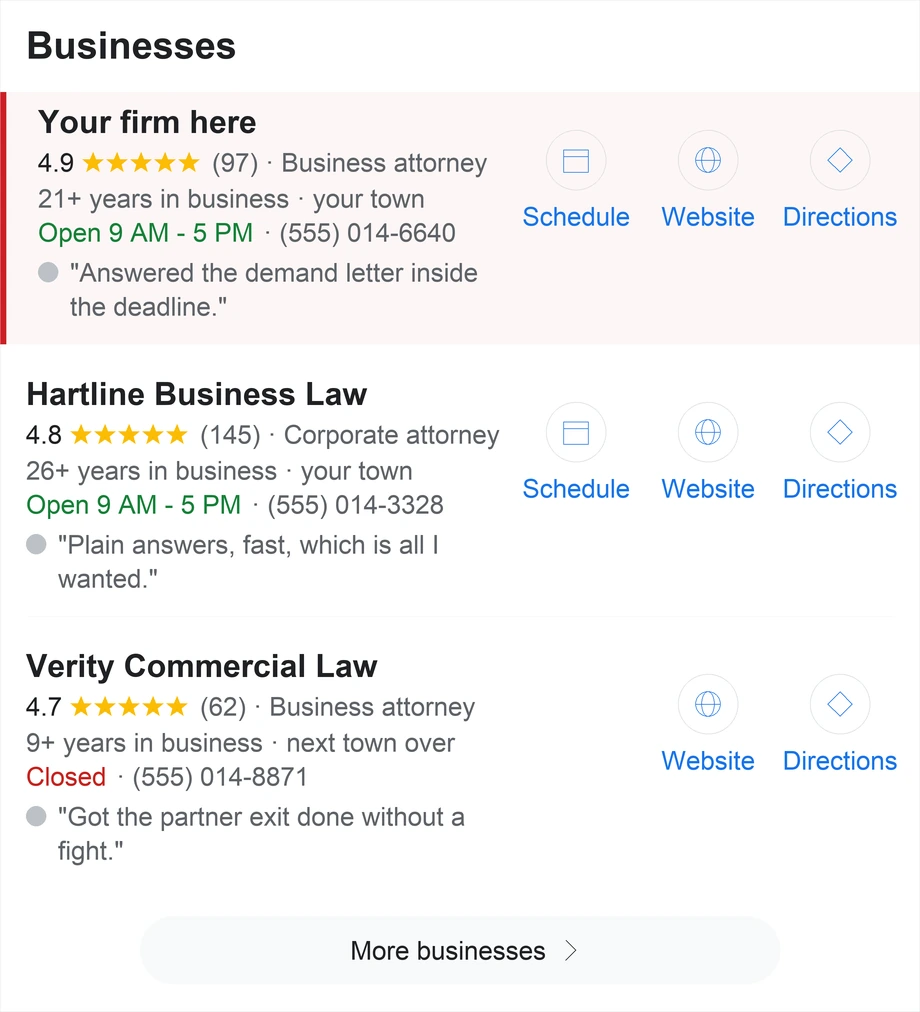
The urgent work has a date, and nobody markets for it
A demand letter names a deadline. A closing has a date. A departing partner has a meeting on Thursday.
Those searches are specific, they’re made by somebody ready to instruct, and they’re far less contested than the general ones every firm competes for.
The longer matters need the other half: staying in front of somebody who already looked at you, because a business owner comparing firms takes weeks and gets interrupted constantly.

Reviews are read by people who will never say they read them
Business clients present as though they decided on the referral alone. They read the reviews anyway, and what they’re checking is responsiveness rather than brilliance.
Below about four stars most people simply stop considering you, which BrightLocal’s 2026 consumer survey puts at 68% of consumers, from 1,002 US adults.
The defensive half matters as much as the offensive one. One unanswered review about slow responses is doing more damage than a month of advertising can undo.
The urgent edge
Not an emergency. Still a date somebody is counting down to.
The assumption that business law has no urgency is why almost nobody competes for the urgent searches.
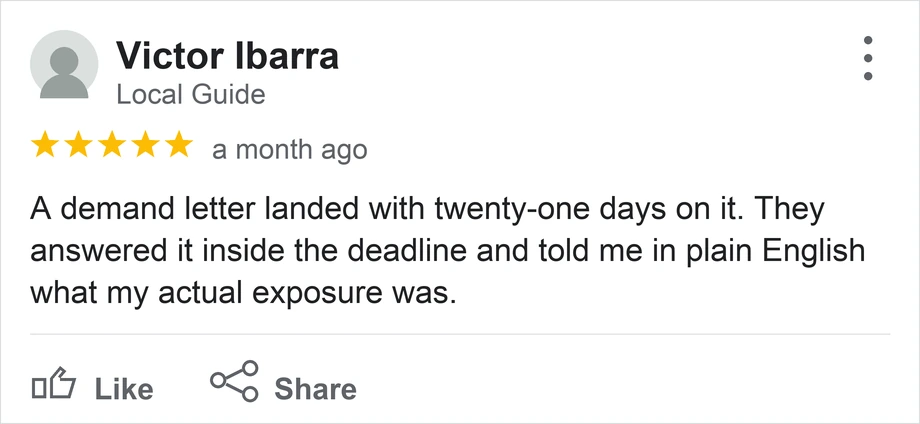
A demand letter with twenty-one days to respond is a deadline. So is a closing, a lease expiry, a regulatory notice, a partner exit that has already been announced internally. In each case the client isn’t researching, they’re trying to get something handled before a date.
Those searches are specific, low in volume and unusually cheap to win, precisely because the rest of the market is writing general pages about business law instead.
Where a business law practice usually starts
Hold up to the referral check, then be findable for the deadline.
Almost nobody should buy all of it at once, and here the referral check sets the order.
In the order it usually makes sense
Everything we do is listed here, and how pricing works is on the homepage, including why we won’t quote a number before we’ve looked at your business.
Straight answer
When this isn’t the right call.
If your capacity is already committed
Leave this alone. Taking on more than you can turn around quickly costs you the one thing business clients actually judge, which is responsiveness.
If you only act for two or three large clients
Then this is the wrong tool. Concentration like that’s a relationship problem and a risk problem, and search does very little for either.
If somebody promised you the number one spot
We aim at the top three positions in the maps in Google and keep you there, for what people actually search. Nobody can honestly promise the top spot.
The referral, and the deadline nobody else answers.
The referral finds a real practice, and the deadline searches nobody else bothers with start finding you. Those are the two gaps a relationship-driven firm actually has.
You’ll see it in two numbers you can count without us: how many calls came in, and how many contact requests came from your website. Not website visitors, not a bunch of fancy, multicolored charts and graphs in a ranking report.
No long-term contract. You stop at the end of the month on almost everything; search is the one exception and takes sixty days’ written notice, because it’s booked ahead.
Frequently Asked Questions
The things worth asking before you buy.
Can you get us to the top of Google for business law in our city?
Yes, into the top three of the local map pack, and we keep you there. That's the block of three businesses that shows above the ordinary results with the map beside it, and it's where the calls come from. You don't need to be first. You need to be one of the three.
The one thing we won't promise is the number one spot, because a position moves with who's searching and where they're standing. Anybody selling you number one is selling you a screenshot.
A ranking promise only means something if it answers two questions: for what, and where. For what, because it's easy to rank a business first for a phrase nobody types, and that's how a ranking guarantee is usually kept. We go after what somebody actually searches when they need you today. And where, because a business ranks in a shape around its address, not everywhere at once. For most that's somewhere between three and seven miles out, depending on how tightly Google draws the map where you are.
And you'll know without taking our word for it. You count the calls and the contact requests from your website. Search takes somewhere between thirty and ninety days to show. If it hasn't, give us our sixty days' written notice.
Read more on this topic: Why we're telling you this at all
What if we want to reach further than three to seven miles?
That's the right ambition and usually the wrong first move. Widening the shape you already have is most of the ongoing work, and every street that comes inside it's people who couldn't see you before and can now. Reaching past it before the near ground is saturated spreads the same money thinner over people who were never going to call you first anyway.
When you genuinely do run out of room, the next move is another area rather than a bigger radius. We build the same shape around an adjoining town, and that repeats for as many areas as you want to take on. There are more advanced ways to push reach as well, and they're worth spending on at that point rather than at the start.
The only real gate is whether you can take the work. We'd rather hold you at one area that's producing than spread you across three that are half fed.
Read more on this topic: How reach is worked out, and what extends it
Our work is all referral. Does search do anything for us?
The referral looks you up before they call, which is the step most firms never account for. If they find a real practice, the recommendation holds. If they find almost nothing, they search generally instead and you're one of three firms with no advantage at all.
That's the quiet way relationship-driven practices lose work they'd already been given.
Business law has no emergencies. Where's the urgency?
In the dates. A demand letter names a deadline to respond. A closing has a date, a lease expires, a partner exit gets announced internally before anybody calls a lawyer.
Those searches are specific, made by somebody ready to instruct, and unusually cheap to win, because the rest of the market is writing general pages about business law instead.
What if we can't take on more work?
Then don't buy this yet. Taking on more than you can turn around quickly costs you the one thing business clients actually judge, which is responsiveness.
Read more on this topic: When we'd advise against it
Book a call
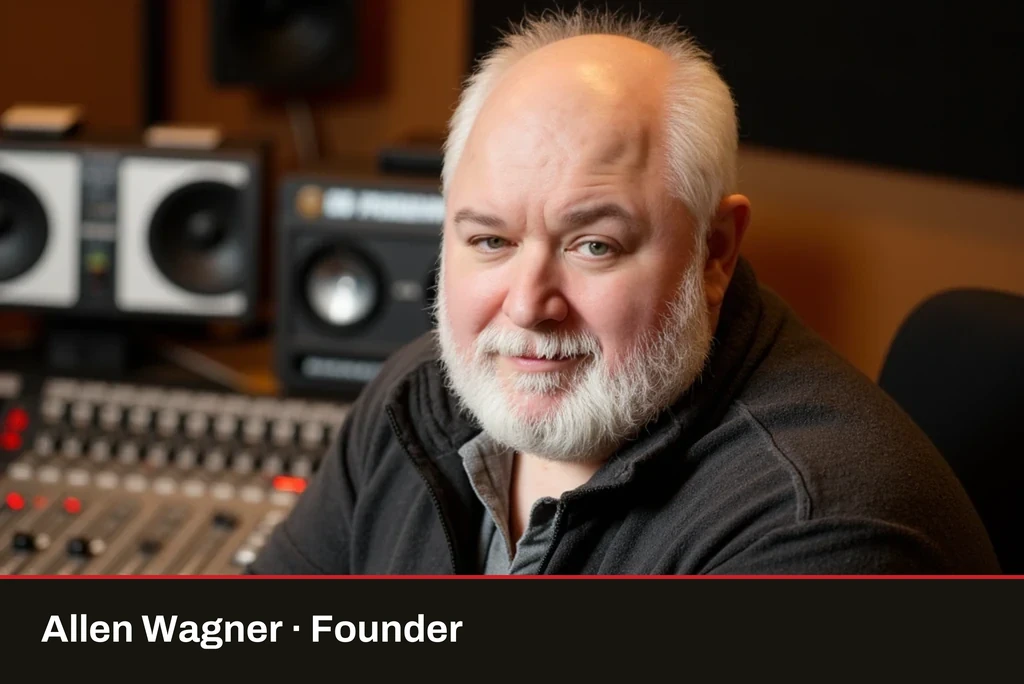
“I'd love to learn about you and your business.”
Ten minutes, and it's mostly me asking what you do, where you do it, and what you've already tried. No pitch deck, no discovery fee, no sales pressure.
Send the form on the rightbelow and I'll set up a call. If we're not a fit I'll tell you right up front and do my best to point you in the right direction.
Call me instead (360) 467-6957