
Law firms
Marketing for Estate Planning Attorneys
No emergencies, but plenty of urgency. Almost every client arrives because something just happened that made putting it off impossible.
Who this is for
Nobody wakes up wanting a will. Something happens, and then they need one this month.
This is the practice most people mean to sort out for years and only act on when something forces it.
A diagnosis. A parent whose memory is slipping and who can still sign today but perhaps not in six months. A funeral that made everybody in the family think about their own affairs. A surgery date, or a flight, or a new baby.
None of that’s an emergency, and all of it is urgent. The client has a reason and a rough deadline, and they’re ready to move in a way they weren’t a month earlier.
That’s the moment you either exist in their search or you don’t.
Why this practice is its own challenge
Trust decides it, and trust has to be visible before you meet.
This is bought almost entirely on trust, because the client can’t judge the document and won’t be around when it matters. Referral carries more weight here than in any other practice on this list.
That has three consequences, and each is a marketing problem rather than a legal one.
The referral still ends in a search
Somebody is given your name by an accountant, a financial adviser, or a friend at church.
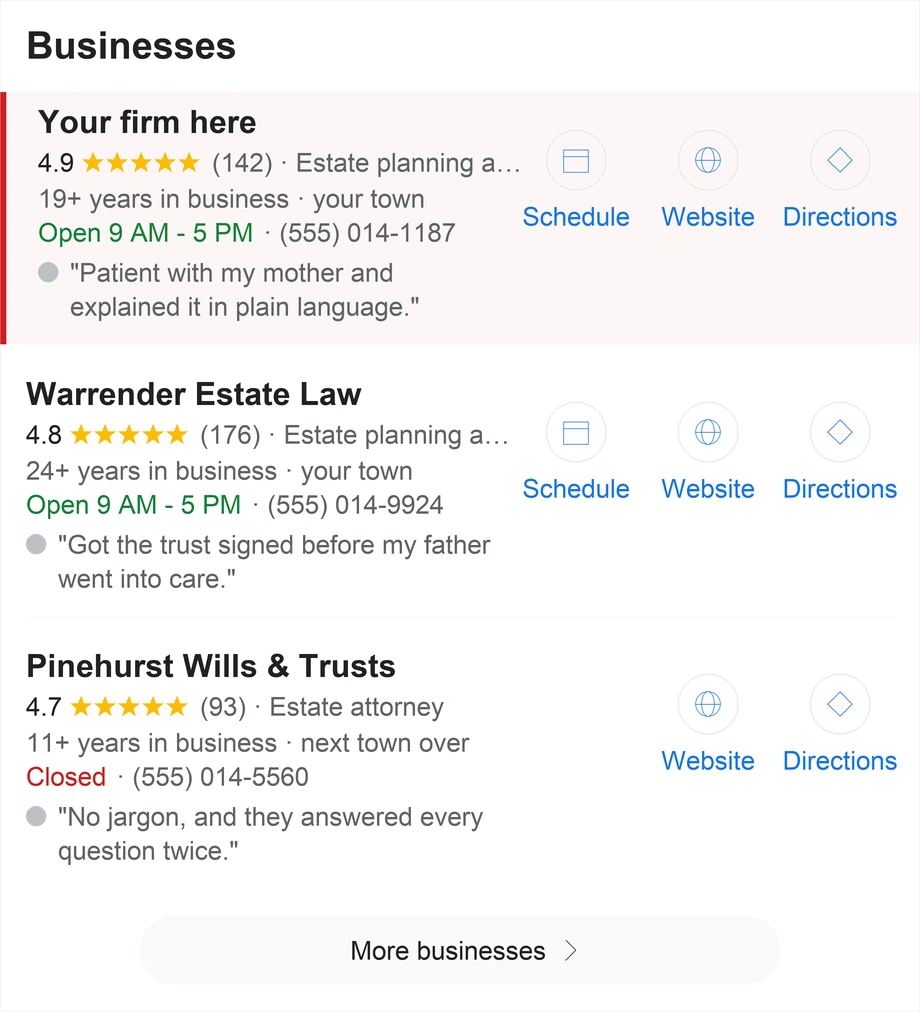
They then look you up before they call, which is the step most firms forget about.
What they find at that moment either confirms the recommendation or quietly undoes it, and if they find nothing at all they usually search generally instead and you’re back in a list of three.
The decision takes weeks, and it’s easy to postpone again
This is a matter people have already put off for years. A quote sits on a kitchen table, life carries on, and the whole thing goes quiet.
The firm that gets the call is usually the one still visible when the client comes back to it, which may be a month later. Staying in front of somebody who already looked at you costs a fraction of reaching them the first time, and here it’s the difference between a matter and a maybe.
It’s also why the urgent subset matters so much: a client with a diagnosis or a signing window doesn’t postpone, and they’re searching right now.

Reviews do the work a referral used to do alone
The client can’t judge the document, so they judge everything around it. Whether it was explained in plain language. Whether the firm was patient with an eighty-year-old parent. Whether anybody called back.
Below about four stars most people simply stop considering you, which BrightLocal’s 2026 consumer survey puts at 68% of consumers, from 1,002 US adults.
The defensive half matters as much as the offensive one. One unanswered review about a family left waiting is doing more damage than a month of advertising can undo.

The urgent subset
Not an emergency. Still a date on a calendar.
The idea that this practice has no urgency is wrong, and it’s why so much estate planning marketing reads as though nobody is in a hurry.
A capacity window is a deadline. So is a scheduled surgery, a move abroad, a diagnosis, a parent going into care. In every one of those the client isn’t browsing, they’re trying to get something signed while it can still be signed.
Those searches use different words from the general ones, and a practice that only publishes the calm version of itself is invisible at exactly the moment somebody is ready to act.
Where an estate planning practice usually starts
Be there when the referral looks you up, and be reviewed for patience.
Almost nobody should buy all of it at once, and here the referral check sets the order.
In the order it usually makes sense
Everything we do is listed here, and how pricing works is on the homepage, including why we won’t quote a number before we’ve looked at your business.
Straight answer
When this isn’t the right call.
If your calendar is already full
Leave this alone. Taking on more than you can draft carefully is how a practice built entirely on trust loses it.
If you only want referral work
You’ll still want the website to hold up, because the referral checks you before they call. That part isn’t optional even if the rest is.
If somebody promised you the number one spot
We aim at the top three positions in the maps in Google and keep you there, for what people actually search. Nobody can honestly promise the top spot.
The referral finds a practice. The deadline finds you.
The referral that looks you up finds a practice, and the client with a deadline finds you at all. Those are two different gaps and most estate planning firms have both.
You’ll see it in two numbers you can count without us: how many calls came in, and how many contact requests came from your website. Not website visitors, not a bunch of fancy, multicolored charts and graphs in a ranking report.
No long-term contract. You stop at the end of the month on almost everything; search is the one exception and takes sixty days’ written notice, because it’s booked ahead.
Frequently Asked Questions
The things worth asking before you buy.
Can you get us to the top of Google for estate planning in our city?
Yes, into the top three of the local map pack, and we keep you there. That's the block of three businesses that shows above the ordinary results with the map beside it, and it's where the calls come from. You don't need to be first. You need to be one of the three.
The one thing we won't promise is the number one spot, because a position moves with who's searching and where they're standing. Anybody selling you number one is selling you a screenshot.
A ranking promise only means something if it answers two questions: for what, and where. For what, because it's easy to rank a business first for a phrase nobody types, and that's how a ranking guarantee is usually kept. We go after what somebody actually searches when they need you today. And where, because a business ranks in a shape around its address, not everywhere at once. For most that's somewhere between three and seven miles out, depending on how tightly Google draws the map where you are.
And you'll know without taking our word for it. You count the calls and the contact requests from your website. Search takes somewhere between thirty and ninety days to show. If it hasn't, give us our sixty days' written notice.
Read more on this topic: What being first is worth if nobody searches it
What if we want to reach further than three to seven miles?
That's the right ambition and usually the wrong first move. Widening the shape you already have is most of the ongoing work, and every street that comes inside it's people who couldn't see you before and can now. Reaching past it before the near ground is saturated spreads the same money thinner over people who were never going to call you first anyway.
When you genuinely do run out of room, the next move is another area rather than a bigger radius. We build the same shape around an adjoining town, and that repeats for as many areas as you want to take on. There are more advanced ways to push reach as well, and they're worth spending on at that point rather than at the start.
The only real gate is whether you can take the work. We'd rather hold you at one area that's producing than spread you across three that are half fed.
Read more on this topic: What the coverage shape is, and how it grows
All our work comes from referrals. Why would we need this?
Because the referral looks you up before they call. That's the step most firms never account for, and what they find either confirms the recommendation or quietly undoes it.
If they find nothing, they usually search generally instead, and you're back in a list of three alongside firms nobody recommended.
Nobody is in a hurry for a will. Does urgency apply here at all?
More than most firms market for. A capacity window is a deadline. So is a diagnosis, a surgery date, a parent going into care, or a move abroad.
In every one of those the client isn't browsing, they're trying to get something signed while it can still be signed, and they use different words from somebody idly planning ahead.
What if we can't take on more?
Then don't buy this yet. A practice built entirely on trust loses it fastest by taking on more than it can draft carefully. Staff first.
Read more on this topic: When we'd say this isn't for you
Book a call
“I'd love to learn about you and your business.”
Ten minutes, and it's mostly me asking what you do, where you do it, and what you've already tried. No pitch deck, no discovery fee, no sales pressure.
Send the form on the rightbelow and I'll set up a call. If we're not a fit I'll tell you right up front and do my best to point you in the right direction.
Call me instead (360) 467-6957